Thursday, 3 February 2022

Nagaswamy - 5 Indian Pictures of Governor Peter Anker

The Ethnographical Museum at the University of Oslo owns a collection of pictures, mainly water colours, from the collection of Peter Anker, Governor of Tranquebar from 1788 to1806, when it was a Danish colony. During a career full of war, diplomacy, economic difficulties, he still resourcefully collected several 13th century bronzes and maps of towns, European fortifications, and landscapes. They were sold after his death to King Christian VIII of Denmark and are now housed in the National Museum in Copenhagen.

Some of these are:

  • The Dansborg fortress
  • A drawing of Kalakkadu, Tinnevelly
  • A rest house in Mayavaram
  • Ruins of old castle in Madura, age of which it has not been possible to discover
  • Gingee fortress in Karnatik
  • The big gate in the pagoda of Seringam in Cauvery river, the largest pagoda in India
  • The Jaggernaut pagoda on North-eastern coast of India

These pictures show a British attachment, in their similar to the Clive Album in Victoria & Albert Museum, opines Nagaswamy. He further states that, “One is apt to believe

  • That Peter Anker came to love the nature of India
  • That he respected Hindu culture
  • That he was interested in Indian Architecture
------

This blogpost is the summary of one of several papers authored by Dr Nagaswamy, which I presented as a lecture at THT Pechu Kacheri 2014. The series is Nagaswamy - Beyond borders   

My blogs on history

My blogs on art


Wednesday, 2 February 2022

Nagaswamy - 4 Jain Art under the Pallavas

The earliest reference to Jain art under the Pallavas, is of Simhanandi in the LokaVibhaaga in Saka 380 or 455 AD. A copper plate of Simhavarman circa 560 AD records gift of a land to Vajranandi, belonging to gana of Nandisangha, in the village Parithikunru, or Vardhamaanesvara Dharmatheertha.

There is an excavated but unfinised cave at Vilapakkam in North  Arcot perhaps of the first Mahendra Varma’s period.

Chandraprabha temple, Tiruparuttikunram, Kanchipuram
Rampant vyala, Chandraprabha temple

A Jain temple dedicated to Chandraprabha in Tiruparithikunram, near Kanchipuram, is assigned to the beginning of 8th century by TN Ramachandran, which is a two storeyed structure. The upper storey seems to be of the Vijayanagara period. The lower floor has rampant vyalas typical of Pallava temples in Kanchi. The ground floor sanctum is closed, but there is a sanctum in the upper floor, similar to the Varadaraja temple in Kanchi. There was passage now blocked, proving this was a saandhaara temple.

Bahubali, cave at Kundavai Jinalayam, Tirumalai, Polur

Tirthankankara, Kundavai Jinalayam


The Jain temple in Tirumalai, near Polur, has sculptures of various periods. The earliest of these are of Parsvanatha with attendants, a seated Tirthankara and Bahubali, undoubtedly Pallava images. The elephants above the panel are in Mamallapuram style. An inscription here refers to an Acharya Arishtanemi of Kadiakottur.

Below a seated Mahavira, are two lines of inscription Tamil, covered by the built up floor.

A group of twenty four Tirthankaras in Thirunaathakunru may be of this period also. A golden yakshi, Ponniyakki image, commissioned by Naaranan in the 50th year of NandiVarma Pallava, is in in Panchapaandavan malai.

An image of a seated Tirthankara in greenish stone in a modern Jaina temple in Saatamangalam, may be assigned to this period. Jaina sculptures are found in Karuppan Kunru. Bhitti, prastaara, griva and shikara elements show that Jain temples had an architecture similar to Brahminical temples of the region.


Tirthankara Rishabanatha, Karuppankunru

Traces of paintings may be seen in Armamalai Jain cave in North Arcot.

The devotional poems cited in Yaapparunkaalam, describing vividly Tirthankaras and Paarshvadevatas, are soul stirring works, very much like Tevaram and Divya Prabhandam.

Credits  These photos of Jain monuments and art were provided by Prof Kanaka Ajita Doss, retired professor of Botany, Presidency College, Madras

----

This blogpost is the summary of one of several papers authored by Dr Nagaswamy, which I presented as a lecture at THT Pechu Kacheri 2014. The series is Nagaswamy - Beyond borders   

Essay Links

Kundavai Jinaalayam - part 1 (in Tamil)

Kundavai Jinaalayam - part 2 (in Tamil)

My blogs on history

My blogs on art

Video Links 

Shyam Raman's lecture on Jainism in Kanchi


S

Tuesday, 1 February 2022

Nagaswamy - 2 Chidambaram and Bengal

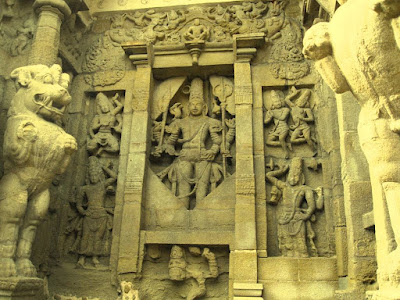
Chidambaram gopuram - inside view

An inscription dated 1262 AD in Chidambaram Nataraja temple mentions uttaraa padattu dakshina raadhattu gangoli tiru ciRRambala uDaiyaar aana uDaiyaar Ishvara shivar. “உத்தராபதத்து தக்ஷிண ராடத்து கங்கொலி  திருச்சிற்றம்பல உடையார் ஆன  உடையார் ஈசுவர சிவர்”

Nagaswamy connects this reference to a Udayiyaar Isvar Shiva mentioned in an inscription in Tribhuvanam temple, built by Kulottunga the 3rd in 1210 AD. He was the royal priest to the king and was also royal priest to Kulottunga’s successor RajaRaja III. He also commissioned a temple in Acyutamangalam.

There are several references to priests from Bengal serving as Rajaguru for the Chola kings. Vikrama Chola in 1125 had SrikanTa Siva of Gauda desa, which is today’s Bengal, Kulottunga II in 1150 had Dhyaana Siva also of Bengal as Royal priest, who wrote commentaries on 28 aagamaas. A Gangoli Umapathi Devar is mentioned in Kanchipuram in 1172.

Vikrama Chola made large donations to Chidambaram, covering balipitha, towers, enclosures and building surrounding the shrine with gold. He built  a great chariot for the processional festival of Nataraja, studded with gems and pearls and instituted a festival on puraTTaadhi and uttiraTTaadhi.

Naraloka Vira, a commander in Vikrama’s army, consecrated images of Jnana Sambandar and Bhattacharya, and arranged for verses of Sambandar to be sung in the temple. He also consecrated images of Gnana Sambanda and a Bhattacharya, which suggests an eastern Saivite aacharya.

भट्टाचार्य इति श्रुतां भुवि शिवां मूर्ति शिवां यो वहन्

संवादं किल वेद बाह्य समयङघातस्य चक्रे पुरा ॥

BhaTTaacarya defeated non-Vedic scholars in debate to establish Saivism. These references to Gangoli and Bhattaacharya are the earliest references in inscription, anywhere in India.

Other earlier references to Bengal include Appar mentioning a temple called Mahasthaana, which is in modern Bangladesh. Gnana Sambandar sings of Vedic Brahmins from the Gangetic delta, who settled in Sirkali.

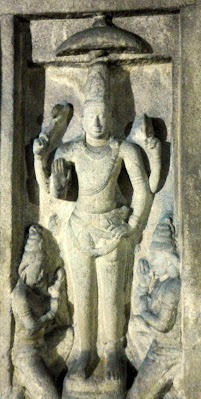
Gnana Sambandar - Chidambaram gopuram

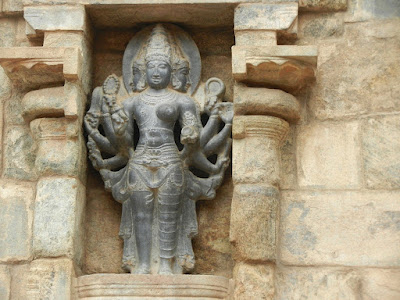
An eight armed Ardhanari Surya, unique to Tamil Nadu, is found in the Darasuram temple – this is Maartaanda Bhairava, introduced by these Acharyas from eastern regions. The four gopurams of the Chidambaram Nataraja temple also have eight armed three faced Surya images.

Marthanda Bhairava  - Darasuram


This blogpost is the summary of one of several papers authored by Dr Nagaswamy, which I presented as a lecture at THT Pechu Kacheri 2014. The series is Nagaswamy - Beyond borders   

My blogs on history

My blogs on art


Sunday, 30 January 2022

Nagaswamy - 1 Ardhanaari Harihara and Nataraja

In this paper, Nagaswamy explains the link between Ardhanari and Harihara, their depictions in verse, in Vedas and Puranas and in Tevaram hymns, and the reflection of these in sculptures and bronzes. 

Poetry inspires Visual Images

Nayanmars Appar and Sambandar sing the Ardhanarisvara form of Siva in their Thevaram hymns on Thiruvenkadu, where there is a magnificent Chola bronze of the 11th century. Consecrated 400 years after the saints, clearly the poets inspired the devotee who commissioned it, says Nagaswamy. He cites another bronze of Valampuram where a Vinadhara Bhikshatana described as “vaTTaNaikaL paTa nadanta naayakar” in an inscription, inspired by this phrase from an Appar hymn. Such images are inspired by poetry.

“வட்டணைகள் பட நடந்து மாயம் பேசி வலம்புரத்தே புக்கங்கே மன்னினாரே”

“தெரித்தொறு வீணையராய் செல்வர் தம்வாய் சிறுமுறுவல் வந்தெனது சிந்தை வௌவ”

Bhikshaatana bronze, Valampuram temple

And it is poetry that helps us understand the common bond between Ardhanarisvara and Harihara, which is explained thus with a quote from Appar : “Hari allaal devi illai ayyan ayyaaranaarkkE”

ஹரி அல்லால் தேவி இல்லை அய்யன் அய்யாரனார்க்கே (ஹரிஹரன்)

Such references are not mere Saiva denigrations of Vishnu, as alleged by some scholars. Harihara is Sung by Alwars and found in Vishnu temples like Namakkal.

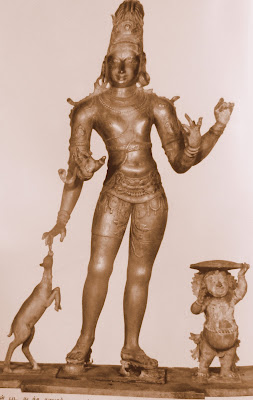
Harihara, AdiVaraha temple, Mamallapuram


The links between Siva depicted as the Infinite Agni – Lingodhbhava, and Agnaa Vishnu as mentioned in the Krshna Yajur Veda, in the Vaasordhaara hymn and its counterpart Shaturudriya hymn are handled deftly. These explain the Ghora (ferocious) and Shivaa (benign) aspect of Shiva respectively. Agni is dual natured : it has Power that burns, and Power that illuminates.

“eri allaadu uruvam illai” says Appar in another hymn linking Siva and Agni.

எரி அல்லாது உருவம் இல்லை (அக்னி ரூபம்)

“रुद्रो वा येष यद् अग्निः”  says the Veda.  There is no rupa for Siva but Agni.

Lingodhbhava, Kanchi Kailasanatha temple


The Linga is a representation of the Infinte Agni, not primarily a phallic symbol, he argues, quoting extensively from the Kurma Purana and Vishnu Purana. Lingodhbhava is depicted extensively in temples from the earliest times. The depiction of Siva as Surya can be found in the aspects of

  • Martanda Bhairava, depicted in Darasuram;
  • the Dance of Surya, the Maheshvara;
  • Gaja Samhara, as a metaphor of a sun emerging from a cloud, like Siva tearing apart the elephant;
  • Siva Bhaskara

MaartaanDa Bhairava, Darasuram


This is also to be seen in the Cosmic Dance of Nataraja, always depicted with Sivakami as the sole witness to the final destruction of all creation. This is represented in the Cit Sabha in Chidambaram. 

Effectively in this paper, Nagaswamy:

  • Connects the three Aspects of Siva
  • Quotes Veda, Kurma Purana, Thevaram to establishes the philosophy of equivalent duality of ArdhaNari and HariHara
  • Introduces the poetic idiom and quotes later use in Inscription
  • Shows Linga is the Agni form of Shiva - Nataraja & Surya
  • Brings out Sculptural Aesthetic
  • Refutes MacDonald and AL Basham about phallic Linga and Harihara as a cult that emerged in Vijayanagara period

This blogpost is the summary of one of several papers authored by Dr Nagaswamy, which I presented as a lecture at THT Pechu Kacheri 2014. The series is Nagaswamy - Beyond borders   

My blogs on history

My blogs on art


Saturday, 29 January 2022

Nagaswamy - beyond borders


Dr Nagaswamy’s contributions on the Global Stage

In December 2014, Tamil Heritage Trust organized a Pechu Kacheri at Tatvaaloka audiotrium, Eldams Road, Teynampet, to honour Dr Nagaswamy, noted archaeologist, historian, and polymath, former Director of the Tamilnadu State Archaeology department. Dr Marxia Gandhi helped put together a panel of people he trained in epigraphy at the TN Archaeology department. They presented his discoveries in various fields like Archaeology, Epigraphy, Coins, Bronzes, Literature etc. On the final day Nagaswamy himself delivered an illustrated lecture on a topic of his choice. He chose the Chola paintings in Rajaraja Choleesvaram, the Big temple in Tanjavur.

On the first day, Prof Swaminathan, founder THT, presented his own take on Dr Nagaswamy's Tamil book "Oviyap Paavai" on the various arts - stone sculptures, paintings, bronzes, wooden images etc - found across the length and breadth of Tamilnadu. The script was based on the excerpt from the book, selected by Swaminathan, and voiced by Nagaswamy.

Prof Swaminathan was kind enough to honour me with the task of presenting a selection of Dr Nagaswamy's papers at international seminars and journals. My lecture, titled "Atyanta - beyond borders" followed that of Swaminathan. 

I met Nagaswamy at his residence around October 2014.  He gave me a few journals and books and pointed out selected articles which were presented or published at international fora. Of these I chose a subset and created a Powerpoint, and brief summary document.

In this series, I will present my brief summary of these papers of Nagaswamy.

------------------------------

Introduction

Dr Nagaswamy’s contributions on the world stage exhibit breadth, depth and sagacity. He has interacted with scholars on Indian art and history from across the world, spoken at museums and universities, submitted path breaking papers and enlightened scholar and layman alike on subjects as diverse as South Indian Bronzes, Art of the Pandyas, identifying the Tanthrapitha Purnagiri, connecting Chidambaram and Bengal, Temples of Village Gods, Jain art under the Pallavas and Dolmens and Hero Stones.

His services as an expert witness in the Pattur Nataraja case, were singled out for praised by the Justices of the London High Court.

Such international scholars as AL Basham, Douglas Barrett, Willem Willets, Mulk Raj Anand have remarked on his scholarship. He has debated scholars like Michael Lockwood on Mahabalipuram and the Rockfort Mahendra Pallava inscription; Michael Witzel on Harappa/Vedas. As a publisher, he has brought out books explaining the spread of Sanskrit and Indian culture in Central, South East and East Asia. His contributions of the links between South India and South East Asia are seminal.

Aesthetic and Idiom

The aesthetic of Indian Art in sculpture, bronze and painting is enhanced by idioms in Indian Languages, especially the vast literature in Sanskrit and Tamil. Art reflects Literature – the Vedas, Puranas, Itihasas, Tevaram, Divya Prabhandham, Tiruvilaiyaadal, Tiruttonda Puranam, have inspired most depictions in temples. An understanding of such Literature enhances a person’s aesthetic sense and enables him to enjoy these works of Art.

By bringing to bear his vast knowledge of literature mentioned above, and others too, on his reading of history from epigraphy, Dr Nagaswamy has enriched the public understanding of such art, and countered the misconceptions of scholars who are unaware of some of these literary works.

His rhetorical skill in drafting the written word and delivering these concepts in resonant oratory are unrivaled.

We present here a selection of papers and lectures he has delivered in international fora and published in foreign journals.

  1. Ardhanaari, Harihara and Nataraja
  2. Chidambaram and Bengal
  3. Purnagiri - the Tantrapitha
  4. Jain art under the Pallavas
  5. The Indian pictures of Governor Peter Anker
  6. Temples of village Gods
  7. Dolmens : Hero stones
  8. Pallava influence on Chalukya art
  9. Temporal seat of authority in Rural and Urban settlements
  10. Art of the Pandyas

Related Links

Nagaswamy - A tribute (in Madras Musings)

Tolkappiyam and Bharata's Natya Shaastra

மயிலாப்பூரில் பல்லவர் இசை

My blogs on history

My blogs on art