Showing posts with label archaeology. Show all posts

Saturday, 23 July 2022

Undiscovered Vishnu temple in Mamallapuram

Mamallapuram has many interesting monuments. Most were abandoned by Indians, stumbled upon by various English and French art enthusiasts, and recovered by archaeologists, under the offices of the Archaeological Survey of India. The earliest was the discovery of several sculptures below ground level at Arjuna’s Penance, by Lord Napier in 1872. A few years later, in 1880, the mostly buried Atiranacanda Mandapam near Tiger cave was extricated from layers of sand, by Alexander Rea. A more recent discovery was of a buried well and some associated sculptures near the Shore temple, in the 1990s. The most recent discovery has been what is called a Sangam era temple near Atiranacanda Mandapam, following the 2004 Indian ocean tsunami.
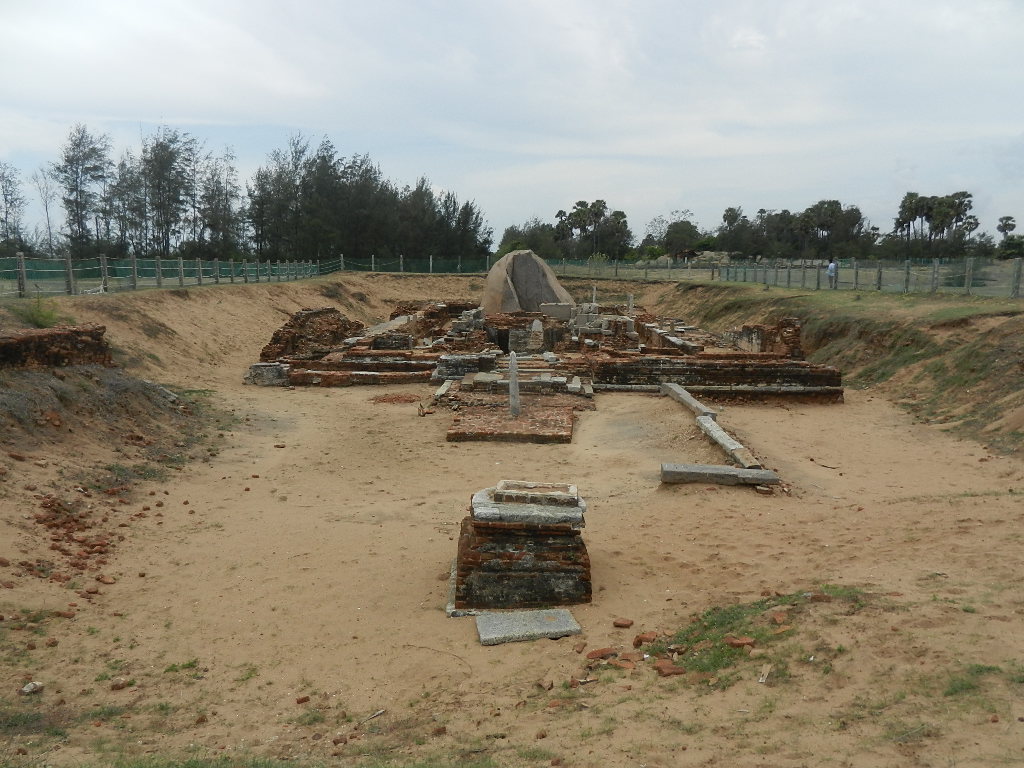
Sangam era Murugan temple, Saluvankuppam
"Inscribed Rock" in Mackenzie's map


Based on the discovery of a stone spear, speculation was that this was  a temple for Skanda or Murugan, though it doesn’t have an image of the deity. Oddly, in the place of the sanctum, there is a deep pit. Equally oddly, it is a half rock, half structural monument, mostly made of bricks (which bear similarity to pre-Pallava bricks elsewhere in Tamilnadu).

This puzzling monument was already described by Colonel Colin Mackenzie, in 1802, as Inscribed Rock (Monument 33). In 1840, says Walter Eliot, this the inscription was transcribed. Eliot appended the transcript in the 1844 paper authored by himself, Braddock, Taylor and Mahon. The meikeerthi indicates this was inscribed by Kulottunga Chola the third.

After the 2004 tsunami, the ASI discovered a second inscription below the sand level, that of Rashtrakuta king Krishna. But there are no Pallava era inscriptions. Only some Pallava monuments in Mamallapuram have inscriptions, so this is not too odd. For example, Atiranachanda has two Pallava and one Chola inscription, but Tiger Cave has none.

In the book Seven Pagodas of the Coromandel Coast, a collection of papers about Mamallapuram, compiled by  Captain MW Carr in 1869, is this transcript by Mackenzie. There is also a map, which shows the Saluvankuppam area, including Tiger Cave, Atiranachanda Mandapa and this Inscribed Rock (now called Murugan temple). West of the Murugan temple, and north of Atiranachanda Mandapa, is a monument labeled Inscribed Stone, in Mackenzie’s map. Near it is an ASI monument marker(Monument 36).

Mackenzie's Stone


Tamil Inscription on Mackenzie's stone

I suspect this Inscribed Stone is the remnant or component of either a buried or lost temple to Vishnu. The inscription itself is in Tamil an is very brief.

ஸ்வஸ்திஸ்ரீ இச்சகதலதமானார்க்கு மதிதவிட்டாகி மாப்பட்டியில் திருவமிதிக்கு இருமாநிலமும் திருவிளக்கு கழஞ்சு பொன்னும் குடுத்தது

Svastishree iccagathalatamaaanaarkku maditavittaagi maappattiyil tiruvamidikku irumaa nilamum tiruviLakku kazanju ponnum kuduttadu

My reading:

ஸ்வஸ்திஸ்ரீ இச்சகதல
தமானார்க்குமுதிதப
ட்டர்குமரபட்டி[திரு]
வமிதிக்கு இருமா[நிலமும்
திருவிளக்கு [கழஞ்சு பொன்]
னும்குடு [த்தது]

Translation: SvastiSree. Two maa of land for food (tiruvamudu) and two kalanju of gold for a lamp (tiruvilakku) are donated for this jaga-tala-tam-aanar and uditta-battar and ara-patti-????

The main temple in worship in Mamallapuram is called Sthalasayana: Sthala means place (or  ground); Sayana means reclining. This word is in stark contrast to the usual pose of reclining Vishnu, when he is always AnantaSayana – reclining on Ananta, or Adisesha, his thousand headed serpent. There is no serpent in the temple. In contrast, the Vishnu in Mahishasura Mardhini mandapam, reclines on his serpent : which is how he is depicted almost everywhere else – in Srirangam, Tirumeyyam, Tiruvanathapuram, Tiruvekka (Kanchipuram) etc. Historians say this temple is of perhaps Vijayanagar vintage (13-15 century AD) rather than Pallava era (5-9 century AD).

Between the two Siva shrines of the Shore temple, is a Vishnu shrine, called Narapati SimhaVishnu Graham. Apparently there is an inscription on the lintel, but perhaps it has eroded : I have never seen it. This shrine also has a Vishnu reclining not on the serpent, but on the bare rock. Perhaps this was the original Sthalasayana; some commentators say that it is called Jalasayana by the locals.


Let us quickly look at two other sets of monuments: Five Rathas and Trimurthi mandapam. Trimurthi Mandapam has three shrines, one each for Vishnu, Siva and BrahmaShasta (Skanda or Murugan, wearing his trademark channavira, but standing in Brahma’s place, with rishis rather than warriors on his side). Also there is a Mahishasura Mardhini on the wall, without a separate shrine. It is an interesting grouping of these three gods and the goddess.

Of the five rathas, four are in a row. Two have deities on the back wall in the sanctum – Draupadi ratha has a standing Mahishasura Mardhini sculpture. Dharmaraja ratha, designed to be a three storey temple, has only one completed sanctum, on the top floor, with SomaskandaH on the back wall. Bhima ratha,very incomplete, looks like it was designed to fit Vishnu in reclining pose; but a major flaw in the rock forced the sthapati to leave it incomplete. Whether it was intended for Sthalasayana or Anantasayana, we can only guess. Arjuna ratha also has an empty sanctum, but it has a figure on the back wall, seated on an elephant. Speculation is that it is either Indra or Muruga. Going with the Trimurthi mandapam pattern, I will guess that it is also Muruga. So both sets have temples for the same four gods. I ignore Sahadeva ratha, since it also has an empty sanctum.

Now let us look at the Saluvankuppam complex. The Atiranachanda mandapam is clearly a shrine for Siva – it has a Somaskanda and a lingam in the sanctum, and the inscriptions both say it is dedicated to Atiranachandeshvara. The tiger cave has an empty sanctum, and may not be a temple at all, but a music hall, as speculated by TN Ramachandran in 1933. The cave mouth is surrounded not by tigers but vyaalis : remarkably there is a mini tiger cave, about a mile south of the Shore temple, very similar in structure; it has a shrine featuring Durga or Mahishasura Mardhini. Prof Baluswamy of MCC conjectures that therefor Tiger cave is also a temple to Mahisharura Mardhini.

Atiranchanda Mandapa buried under sand before 1880
Photograph: Internet (perhaps  shared by ASI )

Atiranachanda mandapa 2014

As we noted earlier, the Murugan temple doesn’t have an image of the deity or even a proper sanctum, but it has the stone spear. We can consider the Inscribed stone, the mysterious monument which is the subject of this essay, to be the fourth monument of this Saluvankuppam set. Since the other three are temples to Siva, Durga and Muruga, this must be for Vishnu, in the pattern of Trimurthi mandapam and Five rathas.

Our strongest clue is the inscription itself. It is a donation inscription; land and gold for food offering and a lamp are donated to cagat-tala-tamaanaar and others. Caga is Tamil tatbhavam for jagat; tala likewise for sthala; tamaanaar (tam+aanaar) is unusual and most likely means the person (he who is). So cagat-tala-tamaanaar is  a Tamil phrase for Sthalasayana. It cant be for the Vishnu in either the Shore temple or the Adivaraha cave or anywhere among the main group in Mamallapuram; it must be for a local temple. If intended for any of the other three, why not inscribe on those? There is plenty of space. The most logical explanation is that, this Inscribed stone is part of the temple, waiting to be discovered from its burial under the same sand that buried most of Atiranachanda mandapa and most of the brick temple. The inscription may be of the Pallava era, based on the shape of some letters, though there is no mention of a king.

It is not clear whether this stone is the floor or the roof of a temple. One would expect an inscription to be on the floor, rather than on the roof. You see inscriptions on the floor in several temples in Mallai, including Atiranachanda, Shore temple, Adivaraha and Ramanuja mantapa. But, the level of this Inscribed Stone is almost the same as the roof of the Atiranachanda mandapa, and above the level of the rediscovered Sangam brick temple. Also, it is exteremely uneven for the floor of a temple. And there are no protuberant pillar bases. So it could possibly be the roof.


So, summarizing, there are three reasons why I think Mackenzie’s inscribed stone, is a buried Vishnu temple.

1.  Caga-tala –tamaanaar  inscription

2.  Level of the sand

3.  Grouping  of four

There are also several arguments against my conjecture.

The first and most obvious is wishful thinking: it would be awesome to just find an undiscovered monument, especially  of the Pallavas.

The second is that, I am unlikely to have stumbled upon something that experts, especially archaeologists, have missed. Wouldn’t Rea or Hunter or the 2004 ASI team have excavated it, if they suspected something?

The third is that, it seems unlikely for an inscription to be on the roof, rather than floor of a temple. It may have been a brick monument that has completely gone, not of Pallava but later era. There is an isolated and ignored torso of  a murthi, perhaps of Vishnu, cast aside among the bushes near the Atiranachanda mandapa. It looks like the remnant of a standing Vishnu. So there may be no monument underground.

These are feeble objections; someone else may have far much better reasons to consider my conjecture wrong.

But I hope someone at ASI believes me and sanctions an exploration. If there is nothing, no harm done, except some wasted time, money and labour. But what if there is a Pallava temple, and a full Sthalasayana?? Can we afford to ignore the possibility?

Related essays

Babington’s Gift – the third Atiranachanda inscription

Lingodbhavasculpture near Shore temple

Essays on Art

Essays on History

Video

2000 Years ofMamallapuram – lecture in Tamil

Babington's third inscription - joint lecture with Dr Nagaswamy


Saturday, 5 February 2022

Nagaswamy - 7 Dolmens: Hero Stones

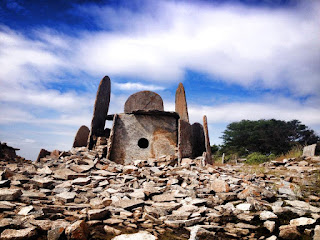
Dolmens, cairn circles, hero stones are megalithic burial sites seen all over Tamilnadu. Dolmens go by various names like Vaaliyaar veedu, kurakku pattadai, Pancha Paandavar padukkai and more popularly as veerakkal or nadukal.  Often personal effects of the buried are also found in small pots with the sarcophagus.


Megalithic cairn circle, Tirupporur
Photo : VSS Iyer


Dolmen 1
photo: Sukavana Murugan

Dolmen 2
photo: Sukavana Murugan

While usually dated to 7th and 8th centuries BC,  some have been dated to as late as the fifth century AD.

Tolkappiyam lists six stages in planting a memorial stone – nadukal

  • Selection of suitable stone
  • Quarrying it
  • Soaking it in water
  • Planting and consecrating after carving the image
  • Offerings
  • Prayers

Other texts list similar stages, but include a final stage where a King or Chieftan builds a temple over the planted stone. These are also listed as kaatchi kaadhai, kalkoL kaadhai, neerpadaik kaadhai, nadukar kaadhai and vaazhthu kaadhai in Silappadikaram.

A Purananuru poem on the death of Kopperunchola by the poet Pottiyar ends “Let us sing the glory of our patron who has become a planted stone.”

A burial urn was made for Nedumavalavan, and a poem addresses a potter that to make his urn, “the whole world should be used as a wheel, and lofty mountain as a lump of clay, suited to his fame.”

Burial urn, Adichanallur, Tamilnadu
Inscriptions Exhibit, Madras University 


A poem of Avvaiyaar on the death of Athiyaman Neduman Anji says a Nadukal was erected for him. It was decorated with peacock feathers and liquor was sprinkled

Nagaswamy connects these customs with current Hindu cremation ceremonies. He cites the contemporary funeral of a Brahmin woman, after whose death two stones were planted, one on the bank of a river, another at the entrance to the house of the deceased; called nadi-theera-kuNDa and gruha-theera-kuNDa respectively. Water was sprinkled over the stone with a towel (vasa udaka) and sesame seeds ( tilodaka ) offered. A potful of drinking water was placed over the stones.A lamp was kept burning throughout. This Vedic ceremony strongly resembles the ceremonies for Athiyaman sung by Avvaiyaar.

The very large number of dolmens and hero stones suggest that these were for all classes of people, including women, in the ancient times. Later this was limited to men of valour and fame.

Bodhyana, Katyayana, and the Vaikhanasa Sutra describe procedures for burial of dead or their ashes. Udayana’s elephant Badraapati which fell in war, was honored by a life size stucco image in a temple and regular worship was arranged, as related in Perunkadai. 

In later times Raja Raja built a colony of housing for dancers around the Big temple. A colony of dancers was established around the temple, Brahmins were fed monthly and a water shed erected for travelers. There were arrangement for exposition of kaavya-s and puraaNa-s. This shows that deification of dead and customs to commemorate them were universalised.

Photo Credits

Dolmens: Sukavana Murugan, Pennar archaeological forum, Krishnagiri 

Burial urns : Inscriptions Exhibit, University of Madras

Cairn circle : VSS Iyer

------------

This essay is one of a series of summaries of papers presented in international seminars by Dr Nagaswamy. The summaries in this series were presented by me at a lecture titled Nagaswamy - Beyond Borders at Tamil Heritage Trusts' Pechu Kacheri 2014 at Tatvaloka, Chennai.

My blogs on history

My blogs on art


Saturday, 29 January 2022

Nagaswamy - beyond borders


Dr Nagaswamy’s contributions on the Global Stage

In December 2014, Tamil Heritage Trust organized a Pechu Kacheri at Tatvaaloka audiotrium, Eldams Road, Teynampet, to honour Dr Nagaswamy, noted archaeologist, historian, and polymath, former Director of the Tamilnadu State Archaeology department. Dr Marxia Gandhi helped put together a panel of people he trained in epigraphy at the TN Archaeology department. They presented his discoveries in various fields like Archaeology, Epigraphy, Coins, Bronzes, Literature etc. On the final day Nagaswamy himself delivered an illustrated lecture on a topic of his choice. He chose the Chola paintings in Rajaraja Choleesvaram, the Big temple in Tanjavur.

On the first day, Prof Swaminathan, founder THT, presented his own take on Dr Nagaswamy's Tamil book "Oviyap Paavai" on the various arts - stone sculptures, paintings, bronzes, wooden images etc - found across the length and breadth of Tamilnadu. The script was based on the excerpt from the book, selected by Swaminathan, and voiced by Nagaswamy.

Prof Swaminathan was kind enough to honour me with the task of presenting a selection of Dr Nagaswamy's papers at international seminars and journals. My lecture, titled "Atyanta - beyond borders" followed that of Swaminathan. 

I met Nagaswamy at his residence around October 2014.  He gave me a few journals and books and pointed out selected articles which were presented or published at international fora. Of these I chose a subset and created a Powerpoint, and brief summary document.

In this series, I will present my brief summary of these papers of Nagaswamy.

------------------------------

Introduction

Dr Nagaswamy’s contributions on the world stage exhibit breadth, depth and sagacity. He has interacted with scholars on Indian art and history from across the world, spoken at museums and universities, submitted path breaking papers and enlightened scholar and layman alike on subjects as diverse as South Indian Bronzes, Art of the Pandyas, identifying the Tanthrapitha Purnagiri, connecting Chidambaram and Bengal, Temples of Village Gods, Jain art under the Pallavas and Dolmens and Hero Stones.

His services as an expert witness in the Pattur Nataraja case, were singled out for praised by the Justices of the London High Court.

Such international scholars as AL Basham, Douglas Barrett, Willem Willets, Mulk Raj Anand have remarked on his scholarship. He has debated scholars like Michael Lockwood on Mahabalipuram and the Rockfort Mahendra Pallava inscription; Michael Witzel on Harappa/Vedas. As a publisher, he has brought out books explaining the spread of Sanskrit and Indian culture in Central, South East and East Asia. His contributions of the links between South India and South East Asia are seminal.

Aesthetic and Idiom

The aesthetic of Indian Art in sculpture, bronze and painting is enhanced by idioms in Indian Languages, especially the vast literature in Sanskrit and Tamil. Art reflects Literature – the Vedas, Puranas, Itihasas, Tevaram, Divya Prabhandham, Tiruvilaiyaadal, Tiruttonda Puranam, have inspired most depictions in temples. An understanding of such Literature enhances a person’s aesthetic sense and enables him to enjoy these works of Art.

By bringing to bear his vast knowledge of literature mentioned above, and others too, on his reading of history from epigraphy, Dr Nagaswamy has enriched the public understanding of such art, and countered the misconceptions of scholars who are unaware of some of these literary works.

His rhetorical skill in drafting the written word and delivering these concepts in resonant oratory are unrivaled.

We present here a selection of papers and lectures he has delivered in international fora and published in foreign journals.

  1. Ardhanaari, Harihara and Nataraja
  2. Chidambaram and Bengal
  3. Purnagiri - the Tantrapitha
  4. Jain art under the Pallavas
  5. The Indian pictures of Governor Peter Anker
  6. Temples of village Gods
  7. Dolmens : Hero stones
  8. Pallava influence on Chalukya art
  9. Temporal seat of authority in Rural and Urban settlements
  10. Art of the Pandyas

Related Links

Nagaswamy - A tribute (in Madras Musings)

Tolkappiyam and Bharata's Natya Shaastra

மயிலாப்பூரில் பல்லவர் இசை

My blogs on history

My blogs on art


Saturday, 24 October 2020

Buddha and the Sahebs - 8 - Ten books that influenced me


I picked up Charles Allen’s The Buddha and the Sahebs at the Eluru Library in Boag Road, Thyagaraya Nagar. It opened up a facet of Indian history that I was almost totally unaware of until then – the European contributions to the rediscovery of India’s past and its enormous role in shaping India’s present and future.

It was as shocking and eye-opening as The Lexus and the OliveTree which made me understand how unaware I was of current affairs, or Sivakamiyin Sabatham, which made me aware of my ignorance of Indian history and Tamil culture. The history I learnt in school, PS Senior Secondary school in Mylapore, was basically half about some aspects of India’s past, and half about British colonialism and India’s independence movement.

A common complaint among Indians nowadays, especially those who take up learning about Indian history in their twenties or later, not from academia but from reading books, tweets, blogs and attending lectures, is that there is too much stress on Guptas and Mughals and almost complete neglect of every other aspect of Indian history. Tamils feel the pang that Cholas and Pandyas are left out, Kannadigas about Hoysalas and Chalukyas, Telugus about Kakatiyas and Satavahanas and so on. Another complaint is that Leftists took over academia, obliterating the noble and glorious accomplishments of not just these dynasties but of poets, scientists, artists, philosophers of that period. While there is some truth to such allegations and angst, reading this made me aware of how widely, deeply, passionately and dispassionately, European scholars, primarily English, and some Indian collaborators had researched vast swathes of India’s buried past; and how much Indians owe an enormous debt to such scholarship. Allen and the geniuses in his book –William Jones, James Prinsep, Alexander Cunningham and others – almost turned me into an Anglophile.

Allen’s book is perhaps the most perfect and scholarly riposte that I have read, to Edward Said’s critique of colonial scholarship – “Orientalism”.

I found Said’s book practically unreadable; Allen’s book is unputdownable.

I later discovered that Allen followed in the footsteps of John Keay, several of whose books I have also enjoyed reading. I think that Indian academics have tossed out the baby of Orientalist scholarship along with the bathwater of European colonial exploitation, at least as far as school textbooks are concerned.

I read this book around 2009 or 2010 I think. I had read some other history books on India before this – Nilakanta Sastri’s History of South India, Abraham Eraly’s Gem in the Lotus (where I first read about Ajivakas), AL Basham’s The Wonder that was India, Jawaharlal Nehru’s Discovery of India, al Beruni’s Indica, Travels of ibn Batuta; and several others I don’t remember.

The Buddha and the Sahebs starts with the discovery, in the late eighteenth century, of several isolated pillars in some major cities lke Delhi and Prayagraj (Allahabad); and remote places like Vaishali, Lauriya Nandangarh and Sanchi in India. Some of them, like that in Ferozeshah Kotla in Delhi and the Allahabad pillar, had inscriptions, not only in Persian in the Arabic script but also others in an archaic Nagari script and a then unknown script which no living Indian could read or recognize. Curious and adventurous Englishmen kept stumbling upon mounds, temples, buried and destroyed monuments, broken idols, abandoned cities, coins, and all kinds of objects, whose existence was a surprise and whose history was a closed book to the most learned Indians of that time. The bureaucrats and scholars brought over from England by the East India Company, to help the businessmen make money, collect taxes and administer society, found endless wonders wherever they looked – if they looked. The formal establishment of a society to study Indian history, geography, culture, literature, law, economy, music, science, medicine, religion etc organized the information they collected across the length and breadth of the land. The very act of organizing, discussing and theorizing produced a wealth of information that astounded eager audiences in Europe, who only had vague notions of what India was from Arabian tales, ancient Greek and Roman travelogues, and the chaotic, disjointed, and sometimes fanciful accounts of sailors and merchants.

The company’s adventurers not only explored India, but also all its surrounding territories – Nepal, Tibet, Burma, Ceylon. The recent field of archaeology was yielding rich treasures in Europe itself, about ancient Rome and Greece; and newly conquered old civilizations like Egypt and Mesopotamia. Some of the Indian pundits who were first skeptical and cautious about the English sahebs, later recognized that some of them were truly curious and eager scholars, and began to both help them and learn all the new fields of knowledge that the European Enlightenment, Renaissance and the  Industrial Revolution had to offer.

Allen explains the travels, discoveries, missteps, surprises, of these Orientalists, who published them under the auspices of the Asiatic Society of Bengal. The tales are as riveting as are their adventures. Their ignorance was sweeping in its scale; what amazed me was how much Indians too were ignorant of their own past, and substituted myth and legend and hearsay for actual history, with no sense of the scale of the eras or the volume and dimension of the events of their past. All of this is presented in school text books in bland and dull prose, as though Indians always knew all this history.

I had a chance to present this exciting story of the rediscovery of India’s past a few times; once at the Indianoil, Patna branch, thanks to a friend, Ganesh, who helped me travel and enjoy several places in Bihar. A second time for INTACH, at the New College in Royapettah, Chennai. And afterwards for THT and Ethiraj college.

The first reading of The Buddha and the Sahebs effected a substantial transformation in my understanding of history. And of the political social and cultural motives that inspired people and institutions to ignore and obfuscate it.

Literature essays in my blog

History essays in my blog

The Asiatic Society of Bengal and the Discovery of India's past


Monday, 6 June 2016

Keezhadi excavation

Amaranath Ramakrishnan,  archaeologist of ASI lectured about the Keeladi excavation which he initiated and is supervising. These are my notes of his speech at Tamil Virtual Academy, Kotturpuram, Chennai.

Tamilnadu Archaeology overview

No serious systematic excavation along Vaigai or Tamilnadu since Alexander Rea in 1880. Occasional expeditions in Kallupatti, Mangulam. Only major ASI dig at Kaveripoompattinam. Alagankulam is the one rare site undertaken by TN state archaeology department.

170 habitation sites found by ASI Bangalore division in the last few years. Including Keeladi, Allinagaram, Enadi, Maranadu with Buddha sculpture (but called Muniyandi), Rajagambiram, Pandikanmay. Most sites are on the South Bank of Vaigai which is lower and hence, fertile.

Burial sites also found too besides habitation sites. Burial sites are never on fertile soil.

Several sites have been lost to real estate and other development.

Stone arrangements are North-south and East-west in Vembur. This is the first such site found in Tamilnadu. Such sites have been discovered in Andhra Karnataka earlier.

Gold bars with Tamil Brahmi (with name Kothai) were found. First gold bar discovered in Tamilnadu. Deposited with Collectorate.

More recent objects

Arabic sluice gate inscription of 17th century. Hero stones, with vattezhuthu, Pandyan era Durga, Jain and Buddhist statues at Arungulam and Kilparthibanur.

Of more recent vintage, (i.e. late Pandya) Karungalakkudi stone temple on the way from Madurai to Nedungulam with Sundara Pandya inscription! Kallikottai Siva temple also discovered!!

Keezhadi

Keezhadi (or Keeladi) now in Siva Ganga district, called Kuntidevi chaturvedi mangalam, after a Pandya queen. Perhaps it is the Kondagai village nearby. 

Puliyur Nambi of 13th century Tiruvilayadal Puranam says old Madurai was near Manalur, which is near Keeladi. It is 80 acres in area.

Bricks of three sizes found. Similar bricks found in Kanchi and Arikamedu. Handmade grooved tiles probably tiled roof, found. Ring well, pottery - for utensil not burial- found in brick dwellings stratigraphically.

Lots of antiquities - all finished goods - found; also coins figurines, glass and pearl beads, iron objects, bone point stylus actually horn, ivory dice, gamesmen, discs and terracotta wheels, Brahmi on pottery sherds with the words Thisan Uthiran Adhan Iyanan Surama. Graffiti pottery sherds also found.

Tamil history is stuck at 3rd century BC. Rajan's dating of Kodumanal as fifth century BC not accepted by anyone.

Nearly one lakh students visited. We allowed them and explained things to them.

Comments by Gopu
I can't find the video of this talk by a Google search. If some one provides a link, I will post the link here. I post this blog because newspaper reports seem more sensational than informative.

Mr Amarnath Ramakrishnan's passion and earnestness came through in the talk. If Keeladi is Sangam settlement like he claims, it is fascinating and important. It is remarkable that most of the sites found earlier were burial sites, not residential areas.

His comments on real estate development are valid. Once land is built up, archaeology is unlikely. I am surpised that there isnt a more active set of excavations around Gangaikonda Cholapuram. 

I hope they commence a proper excavation at Gunduperumbedu also for the same reason. Prof Dayanandan of  MCC, Tambaram expressed this opinion to me in a recent chat.

Other Blogs on Archaeology

A Dholavira surprise
Gunduperumbedu - Creataceous site near Madras

Saturday, 9 May 2015

Athiranchanda Surprise - Babington's Gift


பத்ரி சேஷாத்ரி தமிழில் எழுதியதை இங்கே பார்க்கலாம்
A video of the program at Tamil Arts Academy is here 

Near Mamallapuram, at Saluvankuppam, in the Tiger cave complex, there is a temple cave called Athiranachanda mandapam, built by Rajasimha Pallava. This has inscriptions, both Sanskrit poems, on opposite walls of its verandah, composed by Rajasimha, but in two different scripts - Nagari and Pallava Grantha.
Athiranachanda Mandapam
Athiranachanda inscriptions

The first five stanzas are the same in both inscriptions. and begin with the phrase "Srimatho AthyanthaKaamasya". AthyanthaKaama is a favorite biruda (title) of Rajasimha, which he has also inscribed in Kanchi Kailasantha temple and in Panamalai Talagirisvara temple. The first four stanzas praise Siva. The fifth stanza of this poem says that AthiranchandaH, King of Kings (avanibhujaam patiH), built (akarOt ) this (idam) temple for Athiranachandeshvara; Let Pashupathi, eternally (niyata) delighting (kRtarati) dwell (bhavatu) here (iha), with (sahita) GiriTanaya (Paarvati), Guha (Skanda) and his ganas (gana)

अतिरणचण्ड पतिरवनिभुजाम् अतिरणचण्डेश्वरम् इदं अकरोत् ।
इह गिरितनया गुहगणसहितो नियतकृतरति भवतुपशुपतिः ॥
AthiranchandaH pathiravanibhujaam AthiranchandEshvaram idam akarOt
Iha giritanaya guha gaNa sahitOH niyatakRtarati bhavatu pashupatiH

While the rest of the Sanskrit inscriptions of the Pallavas, in Mamallapuram, are also in Pallava Grantha script, Rajasimha has used not only Pallava Grantha and Nagari, but also a calligraphic Nagari script in the Kanchi Kailsanatha temple.

South wall, Grantha

North wall, Nagari
In 1890, Archaeological Survey of India published all these inscriptions in South Indian Inscriptions, Volume I, edited by E Hultzsch. These are the transcripts used by almost all scholars in all subsequent papers, essays and books on Mamallapuram.

Babington’s Gift

But in 1828, Benjamin Guy Babington, was assisted by someone he calls a "Jain Brahmana" (probably Jain scholar), whose name is not mentioned, who deciphered the Pallava grantha inscriptions at Ganesha Ratha. Babington was not aware of the Athiranachanda Mandapam, but was sent transcripts of this site by Colonel de Havilland. Colonel de Havilland, sent Babington THREE inscriptions of five stanzas - these include the two listed by Hultzsch, and a third one in an entirely different version of the Nagari. The text of this third inscription is exactly the same as the other two. Remarkably, none of the later papers or books on Mamallapuram mentions this third inscription.

When going through a book titled "Seven Pagodas of the Coromandel Coast", by Captain MW Carr, a large copy of which I saw at the library of the Madras Literary Society, on College Road, which included Babington's 1828 paper, I discovered (re-discovered) this forgotten third Rajasimha inscription.

With Siva, Badri and Prof Swaminathan at MLS, looking at Carr's book

Rajasimha's Three inscriptions with modern Grantha, Devanagari transliterations

The third Rajasimha inscription - Rustic Nagari
This inscription cannot be found today - it is perhaps buried under and the ASI may have to excavate around the Athiranachanda mandapam to discover it. It must be remembered that most of the monuments at Mamallapuram were buried upto various levels and recovered by British Orientalists in the 19th century. Only a few years ago, a stone boar, a pillar and stepped pond were discovered next to the Shore temple. And the 2004 Asian tsunami uncovered fragments of a rock which since has been excavated and has revealed a large brick-built complex, perhaps a Murugan temple

Mackenzie’s Map and Chola Tamil inscriptions

Babington's paper also includes copy of a map made by Colin Mackenzie in 1808, which denotes two other objects near Athiranachanda mandapam, marked Inscribed Stone and Inscribed Rock. These also cannot be seen today, but transcripts of these inscriptions in Tamil are presented in a 1844 paper by John Braddock, William Taylor, Walter Elliot and George Mahon, also published in the book by MW Carr. At present, there are ASI monument marker stones, which may mark these.

 
Mackenzie 1808 Map showing Inscribed Rock, Stone near Athiranachanda

Is this the Inscribed Stone?
Is this the "Inscribed Rock"?

The shorter inscription, is as follows, on the Inscribed Stone (described in Walter Eliot’s supplement to the Braddock-Mahon essay as “northwest of this mandapam, No. 32 in the map, level with the surface”):
ஸ்வஸ்திஸ்ரீ இச்சகதலதமானார்க்கு மதிதவிட்டாகி மாப்பட்டியில் திருவமிதிக்கு இருமாநிலமும் திருவிளக்கு கழஞ்சு பொன்னும் குடுத்தது
Svastishree iccagathalatamaaanaarkku maditaviTTaagi maappaTTiyil tiruvamidikku irumaa nilamum tiruviLakku kazanju ponnum kuduttadu

The longer inscription, on the Inscribed Rock (described in Walter Eliot’s supplement to the Braddock-Mahon essay as “About 100 yards north of the Mandapam, is a mass of natural rock, No. 33 in the map, one end of which is covered in long tamil inscription. In 1840, sand was cleared away and a transcript made”)  is quite long, so I will give segments here.

The first two lines are as follows, and Dr Nagaswamy says this is the meikeerthi of Kulottunga Chola the third, and Dr Marxia Gandhi concurs:
ஸ்வஸ்திஸ்ரீ திருவாய்கேழ்வி முன்பாக த்ரிபுவனசக்கரவர்த்திகள்
மதுரையும் ஈழமும் கருவூரும் பாண்டியன் முடித்தலையும் கொண்டு
Svastisree tiruvaaykEzvi munpaaga tribuvanacakkaravarttigaL
Maduraiyum eezamum karuvoorum paaNDiyan muDittalaiyum koNDu

A later section says in the 37th year of Tribhuvana Tevar
த்ரிபுவனதேவர்க்கு யாண்டு _ஙயஎ_ (37)
tribuvantEvarkku yaaNdu 37
ஜயங்கொண்டசோழ மண்டலத்தாமூர்க்கோட்டத்து தேவதானம் ப்ரஹ்மதேயம் திருவிழிச்சலூருடைய ஸுப்ரஹ்மண்யதேவர்கோயில் ஆதிஷண்டேஷ்வர தேவரருளால்
jayangkoNda cOza maNdalattaamoorkOTTatu tEvataanam brahmadEyam tiruviziccalooruDaiya subrahmaNya tEvarkOyil aadiSaNDESvara tEvararuLaal

Without a doubt, these identify the Saluvankuppam area which was called Tiruviziccaloor in Pallava and Chola period and only acquired the name Saluvankuppam in the Vijayanagar period. AadiSanDESvara may be the then prevalent name of AthiRanaChanDESvara – but since it talks of a Subramanya temple, perhaps not. Could this be the same as the rock revealed in the 2004 tsunami, which when excavated showed a large complex built of brick? This latter has a moderately long inscription, which I could not read in person or from photos, but the Mahon paper transcript seems far far longer. I believe that Mackenzie’s Inscribed Stone and Inscribed Rock await rediscovery.

The No. 33 inscription then describes a sale of land in some detail, because of a deficit in the treasury of the temple, which I will skip for brevity.

It continues with a list of signatories – of temple officials – and witnesses – of important people in nearby villages like Tiruporur, Siruthaavur, Paniayur, Visamoor and Mamallapuram.

Discovering Mamallapuram and Pallavas

Babington’s paper, though it has minor flaws, is masterfully scholarly and the work of a fine aesthete. He provides the earliest identification of the inscriptions as Sanskrit, translations of the inscriptions, their similarities, an aesthetic appreciation of the various exquisite sculptures, surprise that Goldingham overlooked those at Varaha Mandapam. His remark that the MahishasuraMardhini is the most dynamic Indian sculpture, will be disputed by very few, even though he qualifies with it the phrase “that he has ever seen”. His drawings, his tables of the Tamil and Grantha alphabets drawn from inscriptions at Mallai are invaluable. Separate tables for the Ganesha Ratha and Dharmaraja Ratha fonts are icing on the cake. His comment on Sanskrit language, as unchanging for long periods, is astute.

Mahon’s paper is a tour de force of global sculpture including those of Egypt, Petra, Syria, Persia etc. Interesting but not directly relevant. Braddock’s Guide is excellent and the perhaps earliest Geographical tour of Mallai, after Kavali Lakshmayya’s similar essay Telugu, which is included along with an English translation in Carr’s book. But ignorance of the Pallava dynasty, mention of a half-savage Jain tribe called Kurumbars, Adondai etc. stand in stark contrast how much more historians know now.

Hultzsch, Alexander Rea, Jouveau Dubreil, KR Srinivasan, C Minakshi etc must get great credit for giving us a proper decoding the history of the Pallavas as a pre-Chola dynasty, and a body of excellent scholarship.

Later Interpretations of Mamallapuram authorship

Until 1962, most scholars believed that monuments Mamallapuram were built by 3 kings, "Mamalla" Narasimha, his grandson Parameshvara and his son Rajasimha. But in 1962, Dr Nagaswamy, Director, Archaeology department, TamilNadu, wrote a paper, titled New Light on Mamallapuram, arguing that Rajasimha was the sole author of all the monuments. He argued that the dating of monuments cannot be done on the basis of variations in pillar design, in scripts, or in architectural variations, but must rest primarily on inscriptions. Some scholars like Stella Kramrisch and DC Sircar agreed with him, while others were not so persuaded. 

A later paper by Michael Lockwood and Gift Siromoney, published in their book Pallava Art, refutes Nagaswamy’s theory. The Lockwood-Siromoney article talks of Babington but only of two inscriptions, not three.

There are several books and papers which deal mainly with the sculptures, but not the authorship. 

Lecture at Tamil Arts Academy

When I sent the photos of Rajasimha’s third inscription to Dr Nagaswamy, on April 15,2015, he was quite delighted and replied by email the next day. On April 17 we both visited the MLS library and perused the Carr book which threw up a couple of other surprises – including a possible line drawing of a temple at the base of the inscription at the Ganesha ratha.

Gopu on Various Researchers on Mallai 

Dr Nagaswamy at Tamil Arts Academy


Dr Nagaswamy organized a presentation at his residence under the auspices of his Tamil Arts Academy, and was extremely generous in sharing the stage and asking me to give an introduction to the Babington and Mahon’s papers. Mr Vijayan, who works at DG Vaishnav College, and who does great service by voluntarily recording several book reviews at Gandhi Study Center, editing and uploading them to Youtube, eagerly recorded this program on May 6, 2015. The video is here.

Dr Nagaswamy believes that the rediscovery of the third Rajasimha inscription, adds strength to his theory. He encouraged everyone to take active interest in the heritage and continue healthy debate on this subject. "Nobody can have the last word," he emphasized.

I look forward to possible excavations by the ASI, and delightful revelations at Saluvankuppam.

In my own way, I felt as thrilled as William Jones and James Prinsep and Alexander Cunnigham and such others must have felt at their massive rediscovery of Indian history

Tailpiece

"Supposd Ancient Place" marked in Mackenzie's map and "a monolithic temple for Varuna, between the Shore temple and the Mahishasura Mardhini rock" in Lakshmayya's paper are two puzzles which also intrigue me!

Acknowledgment

Thanks to Prof Swaminathan for introducing me to Mamallapuram
Thanks to V Chandrasekhar, Vaidyanathan Ramamurthy and Rajasekar Pandurangan for photos
Thanks to Vijayan for video recording
Thanks to friends and enthusiasts of Tamil Heritage Group, too numerous to enumerate, too generous to repay

Afterword 
On May 21, on a second reading of Walter Eliot's Supplement, which is included in the Carr book, I notice that he has mentioned that the Kulottunga Chola inscription is included in an appendix in FW Ellis' "Treatise on Mirasi Rights". I read Ellis' Treatise and I confirm it.

Afterword 2
On a visit to Saluvankuppam on Saturday, May 23, I found Mackenzie's Inscribed Stone (marked as ASI monument stone No. 36) with the words "iccagatala tamaanaarkku" (இச்சகதலதமானார்க்கு)
Mackenzie's stone ASI monument No. 36

Prof Sanakaranarayan of Sanskrit Department, Kanchi Vishva Vidyapeeth, told me in  a phone call that Dr Rajavelu of Tamil University, Thanjavur, has published the Kulottunga Chola inscription - Mackenzie's Inscribed Rock.

VijayKumar, in Singapore, who blogs at PoetryInStone forwarded the video to Dr Michael Lockwood, by email. Dr Lockwood, author of Pallava Art, has engaged me in a delightful email exchange. Initially he was skeptical that there was ever a third Rajasimha inscription, but now he believes it's not an open and shut case. He has written too many things to summarize, but he points out that the Babington / Col de Havilland's transcript No 2 begins Stanza 5 incorrectly "Hima giri" whereas in No 3 it begins "Iha giri"

Afterword 3 - Dr Lockwood's note
I received the following email from Dr Michael Lockwood, after he had read the Afterword No 2 above. I will leave the Afterword 2 unchanged for context. He writes:

"I realize now that I did not express my view to you clearly. I am still highly skeptical that anyone will ever discover the “third” distinct inscription that you are envisioning.

What I did come to the conclusion, after a careful examination of the three transcriptions in Carr’s book, is that I found nothing in the transcriptions with which to strongly twist your logical arm so as to bring you over to my view.

After 39 odd years of wrestling with Pallava epigraphical problems, some of my views rest on a kind of intuitional insight difficult, if not possible, to convey to someone else who holds an opposing view. Yes, of course I may be wrong, but I would, indeed, be highly surprised if that “third” inscription turns up!


Your friendly sparring colleague,
Michael"

Related Links
1. Tamil Arts Academy (Dr Nagaswamy's website)
2. Video of Lecture - New Light at Mamallapuram 
4. Rajasimha’s inscriptions at Kanchi Kailasanatha
6.  Article in Times of India
7.  Article in The Hindu
8.  Saurabh Saxena's detailed essay on Mamallapuram monuments
9.  Video of Lecture - 2000 Years of Mamallapuram (தொன்றுதொட்டு இன்றுவரை மாமல்லபுரம்)