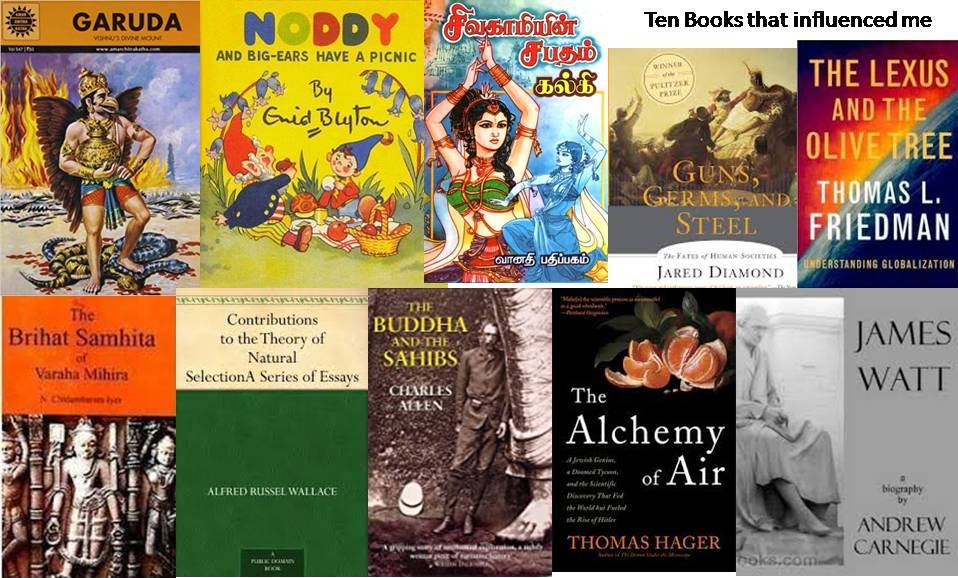
I picked up this book from the now defunct Landmark bookshop
at Spencer’s, along with Darwin’s Armada by Iain McCalman. The latter book was
extraordinarily delightful and informative, describing the ocean voyages of
four scientists, all biologists. I knew about Darwin and Wallace (my blog is
named after Wallace), their co-discovery of Natural Selection, and the great
divergence in their fame and fortunes. I also knew a bit about Thomas Huxley,
famously called Darwin’s Bulldog. But the book gave very detailed information
about their backgrounds, their voyages, adventures, travails, mishaps, discoveries,
surprises, collaborations, friendships, mutual admiration, Wallace falling out
of favour; absolutely riveting stories of nineteenth century biology, some of
which I knew.
Of Fritz Haber and Carl Bosch, the heroes of Thomas Hager’s
book, I knew nothing. My friend and high school chemistry teacher Mohan Krishnamurthy,
says he spent a month teaching the Haber-Bosch process to his students, but I don’t
remember reading it at all in school.
Or ever hearing about it. Anywhere.
I only vaguely knew that NKP, Nitrogen(N) Potassium(K) and
Phosphorus(P) are important elements in fertilizers.
Hager’s book was eye opening in every single way. About
agriculture, about chemistry, chemical engineering, about Germany, German
industry, industrial espionage, guano, South America, the first and second
world wars – I learnt so much about everyone of these areas. Along with Guns, Germs and Steel and Sivakamiyin Sabatham, I rank it the most
informative in multiple domains that book I have read. A year or so later, I
found his other book, The Demon under the
Microscope, equally amazing, informative, and brilliantly narrated.
Hager talks about how vital nitrogen is to life – it is an
essential element in every protein, in DNA, so in every plant and animal cell. But
while Earth’s atmosphere is 80% nitrogen, it is in a form unusable except by a
few microbes, or when it is transformed by lightning into usable nitrogen
compounds. (This raises questions about evolution about which there are no
books or any research that I have come across.)
The book starts with William Crookes’ challenge to the world’s
scientists, to solve the Malthusian threat of famine to a growing human
population. I was only aware of Norman Borlaug’s Green Revolution. This book
made me realize that Haber-Bosch had really given us the first Green revolution
of the twentieth century.
The first two chapters survey the state of agriculture and fertilizers,
across space and time - ancient Rome,
medieval China, colonial India, the Prairies in America and steppes in Russia. Saltpeter
and other nitrogen fertilizer sources, are also raw material for explosives,
and hence their critical for military use. The next three chapters discuss
mountains of guano in South America, nitrates in the Atacama desert, how they
were shipped to European and American farms, and the political and social
turmoil in Peru and Chile.
The next section explains, first, Fritz Haber’s discovery of
the process of making nitrogen form the atmospheric air. Haber succeeded where
much more famous scientists before him failed. The book gives a brief history
of the development of the German chemical industry, and companies like BASF. Haber’s
success was astounding, but not sufficient. To make fertilizer on an industrial
scale, required a vast number of other inventions, financing, investment and Government
backing; and this was mostly overseen by Carl Bosch, an expert in metallurgy,
who didn’t mind working physically with everything. The complexity and enormous
difficulty of translating a laboratory invention to factory production, is
superbly illustrated by the challenges that Bosch faced and the solutions he
came up with. Hager narrates this in great detail, satisfying and enlightening
for the engineer and scientist, not too difficult to understand for the lay
reader. As difficult an accomplishment in writing as whatever Bosch accomplished
in industrial production. This section is the core of the book and explains the
development of the Haber-Bosch process, and its global success in averting
famines and providing alternates for guano.
The third section explains the work of Haber in producing
chemicals weapons for Germany, for WW1; his marital troubles because of this
apparently unseemly activity; the conflict in Europe about whether he should be
lauded as a man who fed the world, or a war criminal who produced deadly
weapons. Haber, a Jew, converted to Christianity, feeling more German than
Jewish. This didn’t help him a decade later, when Hitler rose to power. The
book describes the terrible sufferings Germany went through after its defeat in
the WW1, humiliation, hyperinflation, economic crash and the rise of Hitler and
anti-Semitism. All this was new history to me; the social history is as
fascinating as the scientific and technological one. BASF and Bosch came up
with processes to make petrol substitutes from coal. Germany had a lot of coal
but no oil, and this was vital. The Haber-Bosch process was also vital for
German manufacture of ammunitions, especially explosives. The decline and
disappointment of Haber and Bosch, the two scientists, as Germany conquered and
colonised Europe and then was devastated by Allied Forces, is well narrated in
this section. This also explains why these two people are almost unknown to
most of the world, in spite of their inventing perhaps the most useful scientific
process of the twentieth century.
There are surprising facts scattered around the book. For
example, the Romans had a god of manure! India’s Gangetic plains were a major
source of the best nitrates, and were exported to Britain both for fertile and
ammunitions. This aspect of colonialism was unknown to me. Until reading these
books I thought America is most influential country of the twentieth century;
but I think Germany was at least equally influential. We see the world through
an Anglo-American perspective, because of the dominance of English and
Hollywood, and global media in general.
In 2013, I responded to an email within the THT email group
about some strange phenomena in Indonesia, with a strange explanation. I
replied to the group that the strange phenomenon had a name – the Wallace Line.
This instigated Badri Seshadri, who was in the email group, to tell me I should
start a blog and write such things there, for public consumption, rather than
restrict it to a small group. I had already started the blog in 2012 on the
Mayan Long Count date, but I hadn’t made it public. So I wrote about Haber-Bosch, based on Hager’s book, as my first public blog essay. Even Badri
and Prof Swaminathan were quite impressed; usually they are the ones impressing
other people. And my blog made its way into Badri’s blog honor list – a list of
some of the most popular writers and most influential writers in Tamilnadu, all
100x bloggers. Badri wrote about this book in Tamil, in greater detail than I did. I reviewed this book at Gandhi Study center that year; in Tamil;
and the small audience of about twenty-five stayed put.
I discovered Vaclav Smil via Hager, and a couple of years
later Bill Gates stumbled upon Vaclav Smil too, featuring him often in his
blog. Smil is an energy expert, an amazing analyst and opens up new worlds and
perspectives also. But he is very technical, which doesn’t seem to suit the
general public. But I find his books extraordinary also. For that too, I am
doubly thankful for Hager’s book.
Literature essays in my blog
Chemistry essays in my blog