Showing posts with label Mamallapuram. Show all posts

Saturday, 23 July 2022

Undiscovered Vishnu temple in Mamallapuram

Mamallapuram has many interesting monuments. Most were abandoned by Indians, stumbled upon by various English and French art enthusiasts, and recovered by archaeologists, under the offices of the Archaeological Survey of India. The earliest was the discovery of several sculptures below ground level at Arjuna’s Penance, by Lord Napier in 1872. A few years later, in 1880, the mostly buried Atiranacanda Mandapam near Tiger cave was extricated from layers of sand, by Alexander Rea. A more recent discovery was of a buried well and some associated sculptures near the Shore temple, in the 1990s. The most recent discovery has been what is called a Sangam era temple near Atiranacanda Mandapam, following the 2004 Indian ocean tsunami.
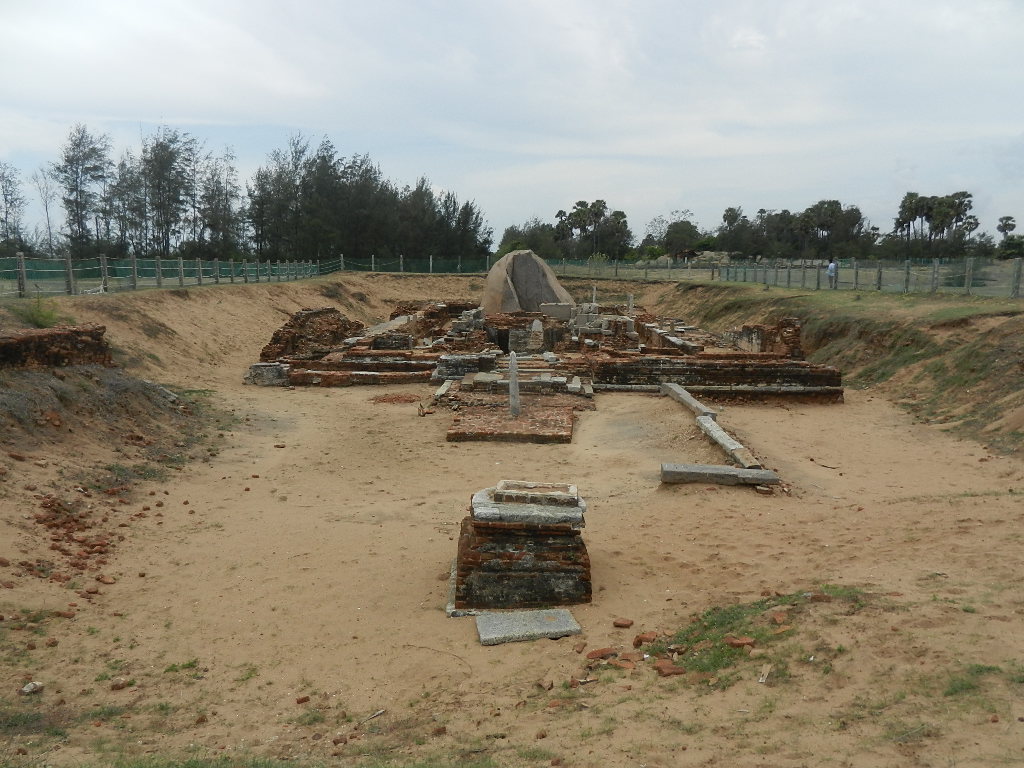
Sangam era Murugan temple, Saluvankuppam
"Inscribed Rock" in Mackenzie's map


Based on the discovery of a stone spear, speculation was that this was  a temple for Skanda or Murugan, though it doesn’t have an image of the deity. Oddly, in the place of the sanctum, there is a deep pit. Equally oddly, it is a half rock, half structural monument, mostly made of bricks (which bear similarity to pre-Pallava bricks elsewhere in Tamilnadu).

This puzzling monument was already described by Colonel Colin Mackenzie, in 1802, as Inscribed Rock (Monument 33). In 1840, says Walter Eliot, this the inscription was transcribed. Eliot appended the transcript in the 1844 paper authored by himself, Braddock, Taylor and Mahon. The meikeerthi indicates this was inscribed by Kulottunga Chola the third.

After the 2004 tsunami, the ASI discovered a second inscription below the sand level, that of Rashtrakuta king Krishna. But there are no Pallava era inscriptions. Only some Pallava monuments in Mamallapuram have inscriptions, so this is not too odd. For example, Atiranachanda has two Pallava and one Chola inscription, but Tiger Cave has none.

In the book Seven Pagodas of the Coromandel Coast, a collection of papers about Mamallapuram, compiled by  Captain MW Carr in 1869, is this transcript by Mackenzie. There is also a map, which shows the Saluvankuppam area, including Tiger Cave, Atiranachanda Mandapa and this Inscribed Rock (now called Murugan temple). West of the Murugan temple, and north of Atiranachanda Mandapa, is a monument labeled Inscribed Stone, in Mackenzie’s map. Near it is an ASI monument marker(Monument 36).

Mackenzie's Stone


Tamil Inscription on Mackenzie's stone

I suspect this Inscribed Stone is the remnant or component of either a buried or lost temple to Vishnu. The inscription itself is in Tamil an is very brief.

ஸ்வஸ்திஸ்ரீ இச்சகதலதமானார்க்கு மதிதவிட்டாகி மாப்பட்டியில் திருவமிதிக்கு இருமாநிலமும் திருவிளக்கு கழஞ்சு பொன்னும் குடுத்தது

Svastishree iccagathalatamaaanaarkku maditavittaagi maappattiyil tiruvamidikku irumaa nilamum tiruviLakku kazanju ponnum kuduttadu

My reading:

ஸ்வஸ்திஸ்ரீ இச்சகதல
தமானார்க்குமுதிதப
ட்டர்குமரபட்டி[திரு]
வமிதிக்கு இருமா[நிலமும்
திருவிளக்கு [கழஞ்சு பொன்]
னும்குடு [த்தது]

Translation: SvastiSree. Two maa of land for food (tiruvamudu) and two kalanju of gold for a lamp (tiruvilakku) are donated for this jaga-tala-tam-aanar and uditta-battar and ara-patti-????

The main temple in worship in Mamallapuram is called Sthalasayana: Sthala means place (or  ground); Sayana means reclining. This word is in stark contrast to the usual pose of reclining Vishnu, when he is always AnantaSayana – reclining on Ananta, or Adisesha, his thousand headed serpent. There is no serpent in the temple. In contrast, the Vishnu in Mahishasura Mardhini mandapam, reclines on his serpent : which is how he is depicted almost everywhere else – in Srirangam, Tirumeyyam, Tiruvanathapuram, Tiruvekka (Kanchipuram) etc. Historians say this temple is of perhaps Vijayanagar vintage (13-15 century AD) rather than Pallava era (5-9 century AD).

Between the two Siva shrines of the Shore temple, is a Vishnu shrine, called Narapati SimhaVishnu Graham. Apparently there is an inscription on the lintel, but perhaps it has eroded : I have never seen it. This shrine also has a Vishnu reclining not on the serpent, but on the bare rock. Perhaps this was the original Sthalasayana; some commentators say that it is called Jalasayana by the locals.


Let us quickly look at two other sets of monuments: Five Rathas and Trimurthi mandapam. Trimurthi Mandapam has three shrines, one each for Vishnu, Siva and BrahmaShasta (Skanda or Murugan, wearing his trademark channavira, but standing in Brahma’s place, with rishis rather than warriors on his side). Also there is a Mahishasura Mardhini on the wall, without a separate shrine. It is an interesting grouping of these three gods and the goddess.

Of the five rathas, four are in a row. Two have deities on the back wall in the sanctum – Draupadi ratha has a standing Mahishasura Mardhini sculpture. Dharmaraja ratha, designed to be a three storey temple, has only one completed sanctum, on the top floor, with SomaskandaH on the back wall. Bhima ratha,very incomplete, looks like it was designed to fit Vishnu in reclining pose; but a major flaw in the rock forced the sthapati to leave it incomplete. Whether it was intended for Sthalasayana or Anantasayana, we can only guess. Arjuna ratha also has an empty sanctum, but it has a figure on the back wall, seated on an elephant. Speculation is that it is either Indra or Muruga. Going with the Trimurthi mandapam pattern, I will guess that it is also Muruga. So both sets have temples for the same four gods. I ignore Sahadeva ratha, since it also has an empty sanctum.

Now let us look at the Saluvankuppam complex. The Atiranachanda mandapam is clearly a shrine for Siva – it has a Somaskanda and a lingam in the sanctum, and the inscriptions both say it is dedicated to Atiranachandeshvara. The tiger cave has an empty sanctum, and may not be a temple at all, but a music hall, as speculated by TN Ramachandran in 1933. The cave mouth is surrounded not by tigers but vyaalis : remarkably there is a mini tiger cave, about a mile south of the Shore temple, very similar in structure; it has a shrine featuring Durga or Mahishasura Mardhini. Prof Baluswamy of MCC conjectures that therefor Tiger cave is also a temple to Mahisharura Mardhini.

Atiranchanda Mandapa buried under sand before 1880
Photograph: Internet (perhaps  shared by ASI )

Atiranachanda mandapa 2014

As we noted earlier, the Murugan temple doesn’t have an image of the deity or even a proper sanctum, but it has the stone spear. We can consider the Inscribed stone, the mysterious monument which is the subject of this essay, to be the fourth monument of this Saluvankuppam set. Since the other three are temples to Siva, Durga and Muruga, this must be for Vishnu, in the pattern of Trimurthi mandapam and Five rathas.

Our strongest clue is the inscription itself. It is a donation inscription; land and gold for food offering and a lamp are donated to cagat-tala-tamaanaar and others. Caga is Tamil tatbhavam for jagat; tala likewise for sthala; tamaanaar (tam+aanaar) is unusual and most likely means the person (he who is). So cagat-tala-tamaanaar is  a Tamil phrase for Sthalasayana. It cant be for the Vishnu in either the Shore temple or the Adivaraha cave or anywhere among the main group in Mamallapuram; it must be for a local temple. If intended for any of the other three, why not inscribe on those? There is plenty of space. The most logical explanation is that, this Inscribed stone is part of the temple, waiting to be discovered from its burial under the same sand that buried most of Atiranachanda mandapa and most of the brick temple. The inscription may be of the Pallava era, based on the shape of some letters, though there is no mention of a king.

It is not clear whether this stone is the floor or the roof of a temple. One would expect an inscription to be on the floor, rather than on the roof. You see inscriptions on the floor in several temples in Mallai, including Atiranachanda, Shore temple, Adivaraha and Ramanuja mantapa. But, the level of this Inscribed Stone is almost the same as the roof of the Atiranachanda mandapa, and above the level of the rediscovered Sangam brick temple. Also, it is exteremely uneven for the floor of a temple. And there are no protuberant pillar bases. So it could possibly be the roof.


So, summarizing, there are three reasons why I think Mackenzie’s inscribed stone, is a buried Vishnu temple.

1.  Caga-tala –tamaanaar  inscription

2.  Level of the sand

3.  Grouping  of four

There are also several arguments against my conjecture.

The first and most obvious is wishful thinking: it would be awesome to just find an undiscovered monument, especially  of the Pallavas.

The second is that, I am unlikely to have stumbled upon something that experts, especially archaeologists, have missed. Wouldn’t Rea or Hunter or the 2004 ASI team have excavated it, if they suspected something?

The third is that, it seems unlikely for an inscription to be on the roof, rather than floor of a temple. It may have been a brick monument that has completely gone, not of Pallava but later era. There is an isolated and ignored torso of  a murthi, perhaps of Vishnu, cast aside among the bushes near the Atiranachanda mandapa. It looks like the remnant of a standing Vishnu. So there may be no monument underground.

These are feeble objections; someone else may have far much better reasons to consider my conjecture wrong.

But I hope someone at ASI believes me and sanctions an exploration. If there is nothing, no harm done, except some wasted time, money and labour. But what if there is a Pallava temple, and a full Sthalasayana?? Can we afford to ignore the possibility?

Related essays

Babington’s Gift – the third Atiranachanda inscription

Lingodbhavasculpture near Shore temple

Essays on Art

Essays on History

Video

2000 Years ofMamallapuram – lecture in Tamil

Babington's third inscription - joint lecture with Dr Nagaswamy


Wednesday, 13 May 2020

Labour Statues of Mamallapuram

மாமல்லபுரத்து உழைப்பாளர் சிலை (Tamil version of this essay)


There is a statue called Triumph of Labour, opposite to the Senate Building of the Madras university and adjacent to the MGR and Jayalalitha graves at the Marina beach in Madras. This was designed by Roy Chowdhry, a former Principal of the Government College of Fine Arts, Egmore. The college is only  a couple of miles away from the statue.

It depicts four people straining their sinews in hard physical labour, trying to move a large boulder with a long rod. It was not only art, but a political statement, a celebration of Marxism and democracy. a tribute to the Labour movement of the early twentieth century.

Labour Statue, Marina beach, Madras

There are several other statues in the Marina beach, mostly commissioned and installed to mark the World Tamil Conference held in 1968. The previous year 1967, the Dravida Munnetra Kazhagam won elections and formed the government. These statues are celebration of Tamil literature, culture and the Dravidian movement, an alternate to the Congress and the Communist parties that were popular until then in Tamilnadu. Hence there are statues to ancient poets Tiruvalluvar, Ilango  and Avvaiyar, modern poets Subramania Bharati and Bhaaratidaasan, and Kannagi, the heroine of the Ilango’s great epic Silappadikaaram. A statue for the medieval Tamil poet Kamban was added in 1971. 

Three foreigners who enriched Tamil literature were also  honored with statues. They are : Italian priest Constantine Beschi (who called himself Veeramaamunivar in Tamil and wrote the story of Jesus Christ as the Tamil epic Tembaavani,), English Bishop Robert Caldwell, then considered the discoverer of the Dravidian language family, and GU Pope, who translated Tirukkural and Tiruvaasagam into English.

Before the era of British rule in India, statues in public were rare. There are no mentions of such statues in literature and no archaeological evidence. After India became independent, Indians adopted the British custom and festooned the country with statues of politicians in practically every street. In Madras, there are also statues to poets, authors and cinema actors.

While most of these other statues in Chennai may not excite connoisseurs or critics of art, the Labour statue is quite noteworthy. But rarely do visitors come to see this statue for its artistic merit. It is simply something else to on their way to the beach. People who visit Madras to see sculptures visit either the Egmore museum or Mamallapuram.

Art Galleries


Temples are the galleries of art of India, for painting sculpture or architecture. They are the monuments which are renovated least and hence offer the best snapshots of the past. Parthasarathy temple in Tiruvallikkeni is perhaps the temple in Chennai with oldest sculptures, of the Vijayanagar period.

Art historians consider Mamallapuram the cradle of Dravidian architecture and sculpture. (Here Dravidian refers to a style of sculpture as per the Hindu shilpa shaastras, not the language family or the political movement). Some of Mahendra Pallava’s caves precede Mamallapuram, but have few sculptures, all of Gods or dvarapalakas. Few people visit them. From the Pallava era, and even earlier, till now, temples are the primary art galleries of not just Tamil country, but also India. Several historians and scholars, primarily Marxists but also quite a few others, inject political and social perspectives to temples and sculptures, but the fundamental intention of temples continues to be religion. The art serves the religion. 

In the centuries that followed Mamallapuram, when temples in granite proliferated the Tamil country, the sculptures of the Pallavas, Pandyas, Cholas or their feudatories, all depicted episodes from the itihaasas Ramayana and Mahabharata, the Puranas or the episodes from the lives of the Alwaars or Naayanmaars. Only from the Vijayanagar era, ordinary people, kuravan kuratti, scenes of daily life etc started to proliferate.

But Mamallapuram is an exception.


The Worker Sculptures of Mamallapuram


The Great Penance panel in Mamallapuram or Mallai, depicts either Arjuna or Bhagiratha in penance, as Siva appears to grant his book. Devas, Gandharvas, Rishis, Vidyadharas, Kinnaras, Kimpurushas, flock to see this marvelous sight. A number of birds and animals are also featured in the magnificent spectacle. Among these are four hunters, or kiraatas. Kiraataarjuniyam was a great Sanskrit epic, composed by Bharavi around this time. Siva disguised as a kiraata arrives to test Arjuna : the test turns into a war first of words, then arrows, then hand to hand combat. The Penance panel doesn’t feature Siva as a kiraata, but the four kiraatas in the sculpture may indicate this episode. They all carry tall bows, but none bears the carcass of a hunted animal. One carries a jackfruit.

Great Penance panel - Mamallapuram

They are not gods, or royalty or landed gentry, but daily toilers. They are not shown lifting or moving something heavy, straining their muscles, suffering from the heat of the midday sun, or sweating profusely. They are working for themselves, not being exploited by a moneyed class. Nothing for a Marxist to criticize, an union leader to organize, a writer or artist to lament, or a social justice warrior to exploit. There maybe some scope for an anthropologist or an art critic, but they generally seem to have ignored such sculptures.

Kiratas in the Great Penance

A curious aspect is their neutral expression – there is none of the vismaya of the celestials, the languidness of the animals at rest, or the delight of the elephants charging towards the water.

A stone’s throw from the Penance panel is the Govardhana Panel. Krishna lifts the mountain with his hand, with Balarama Subhadra and a host of the Yadavas and their cattle all taking refuge under it. The most remarkable aspect here is the utter normality of village life while a storm rages all around. Here a cowherd milks a cow, a lady vends her buttermilk, another carries a pile of straw on her head, a man plays the flute, his wife warns him that it is disturbing the sleeping baby, and so on. All people at work; but the primary intent of the sculptor is show the Grand Deed of Krishna, not the toil of the workers.

center: Krishna lifting Govardha
right : Lady carrying pots with buttermilk

right: Yaadava milking cow
left: Lady carrying straw

The Dharamaraja ratha, tallest of the Five Rathas, features several marvelous sculptures in the second and third floor, mostly of Siva and some of Vishnu, and their devotees. Among these are five temple workers – a priest (archaka), an attendant with a bell in his hand (parichaaraka), a cook (svayampaka), a water bearer (a lady with a pot) and a musician (oduvaar). Four of these are on the eastern wall, the lady with the pot is in the western wall. 


As temples became bigger, they acquired a larger band of workers, but none of the later Pallava or Chola temples ever depicts a single such worker.

In some temples of the Nayak era, sculptures of kings, queens, ministers, generals and donors are etched on some pillars. But in the ancient and medieval era, not a single poet, administrator, artist, architect, businessman, scientist, scholar, were apparently considered fit to commemorate with statues in temples. We have no idea what Kamaban Tiruvalluvar Ilango Avvaiyaar and others looked like. We don’t even know the names of the sthapathis and silpis of most of the temples, leave alone portrait sculptures. Perhaps some were featured in paintings in palaces or palm leaf manuscripts or other forms of painting, now lost.

In this respect, the statues of the workers, commoners as depicted in Mamallapuram remain unique.

If you liked this essay, check out other such essays by me 


Wednesday, 28 June 2017

Lingodhbhava at Mamallapuram Shore temple

Water-tank (dry) near Shore temple
Left to right: Varaha, Pillar temple, Spring

Left: Diving Varaha when tank has some water
Right: Rishabantika Siva in the pillar shrine


Just to the north of the twin shore temples at Mamallapuram is an excavated granite water tank (or pond) with some unusual sculptures of the Pallava era. From south to north, they are a digging (diving, rather) Varaha, a pillar temple and a natural spring with a jala-kanya sculpture. These were not discovered until the 1990s by the ASI, being buried in the sand until then. Scholars seem to have not hazarded too many guesses at what this tank could be, though it seems obvious to me. NS Ramaswamy’s book “2000 Years of Mamallapuram” summarises a paper that PL Samy published, titled “Water cult in Mahabalipuram”, in Journal of Tamil Studies, Tuticorin, 1975. Not too many new books on  Mamallapuram have appeared after the excavation of the tank. And they have concentrated on the other aspects of Mamallapuram.

The Varaha sculpture is carved out of the mother rock like the three other animal sculptures in the Five Rathas nearby. It has four birudas (titles) of Rajasimha Pallava, some of his favorites, inscribed upon the base, in Sanskrit in the Pallava Grantha script. The birudas on the side are “Sri RajasimhaH” “Sri RanajayaH” and “Sri BharaH”. The biruda on the rear, under the varaha’s tail, is “Sri Citra KaarmukaH”. Between the legs of the boar on both the and under its tail, leaves of acquatic plants are sculpted. These are similar to those at the base of the Varaha and Gajalakshmi panels in the Varaha Mandapam. These indicate that the boar which represents Vishnu, is diving under water, not merely digging.

Sanskrit inscriptions in Pallava Grantha script-
Sri RaajasimhaH Sri RaNajayaH Sri BharaH
श्री राजसिंहः श्री रणजयः श्री भरः 

The pillar temple, unique even to Mamallapuram, has a small shrine in its middle, about a foot square, with a bas-relief of Siva as Rishabantika on the back wall. The base, part of the mother rock, like the Varaha, has clearly sculpted features that are part of the adishtana, with the lowest level a sixteen sided polygon and everything above it circular. The small shrine has two dvarapalas on seated lions with raised paws. Two similar pilasters adorn the rear of this shrine. The pillar shrine clearly has a kodungai, greeva and a shikara. That it is a temple is not in question. It contrasts nicely with a seated lion shrine on the south side of the Shore temple, which features a similar excavated small shrine, with Mahishasura Mardhinion on the back wall. This lion-vahana temple has a Pallava copy in the mini-tiger cave complex a further half-a-kilometer south of the Shore temple, but the pillar temple has no Pallava imitations. The only attempts at imitation which I can think of, are the modern cement-conrete pilaster shrines in most houses and apartment complexes, all over India, which usually have Vinayaka idols.

A panoramic photo of Rishabhantika Siva
with Brahma and Vishnu flanking him

About three feet north of the pillar temple,  is a freshwater spring (called sunai in Tamil). It has a sandy base when dry, and seeps water occasionally. It has a flawless circular ring wall, about two feet in diameter, with a niche at the eastern side, which has a sculpted figure of a jala-kanya (water-maiden) and her chaamara-kanyas (whisk-bearers). 

The Spring, when dry
Sandy bed. Jalakanya sculpture

Spring under water

Clearly the whole stepped tank was designed to fill up with fresh water, either from the spring, or by rain. Notice that the topstep of the watertank is lower than the greeva of the pillar temple. If the tank ever filled up to the brim, the shikara would still be above the water level. This is quite significant and by design.

I believe the pillar temple is not merely a temple, but  a representation of Siva as Lingodhbhava and is integrated into the tank for this purpose. There is no other Lingodhbhava at Mamallapuram, but there is a magnificent Lingodhbhava on the southern wall of the Kanchi Kailasanatha temple, also built by Rajasimha Pallava. Eight armed , and encased in a rhombus like pattern of four slanted lines within a rectangular niche, neither the feet of the Lingodhbhava nor the tip of his crown (jata-makuta or matted hair) are shown, just as they were not seen by Brahma or Vishnu. To his sides below his waist are Brahma and Vishnu, standing in adoration. Above them respectively are (1) Brahma flying (b) Surya and Chandra flying, Siva’s jata-makuta raising over them. Directly under Siva, is shown a four armed boar, carrying the conch (shankha) and discus (chakra), the weapons of Vishnu.This is severaly damaged, but it is unmistakeable. In later Chola sculptures, a similar Lingodhbhava but more cylindrial, with Siva in an oval rather than rhombus-like interior, can be seen with a hamsa (swan) representing Brahma. Often Brahma himself is seated on the swan.

Lingodhbhava - Kanchi Kailasanatha temple
Varaha below Lingodhbhava
Lingodhbhava at Sivapuram
near of Coovam river

Brahma on hamsa - Sivapuram

Vishnu as Varaha, Sivapuram
Brahma on hamsa - Konerirajapuram

Living Sculptures: Water in the Bas-Relief Panels

Prof Baluswamy in his Tamil books அர்சுணன் தபசு Arjunan Tapasu (about Arjuna’s Penance) and புலிகுகையும் கிருஷ்ண மண்டபமும் Puli Kugaiyum Krishna Mandapamum (about Tiger Cave and Krishna Mandapam), showed that not only the Arjuna’s Penance bas-relief, but also the Govardhana bas-relief in Krishna Mandapam had water themes. The cleft in the middle of the Arjuna Penance indicated the Ganga, which led Victor Goloubew to propose that it is Bhagiratha’s Penance rather than that of Arjuna. And several scholars have pointed out that there existed a brick-and-mortar cistern at the top of the cleft. So when rain filled up a tank there, and water flowed out, viewers would see a torrent of water pouring down the Ganga cleft – rendering it a living sculpture, where water was integrated with the stone figures. Baluswamy argued that the Govardhana panel was also a living sculpture, before Vijayanagar kings built a mandapam preventing rain. Imagine seeing Krishna lift the Govardhana panel through the drizzle as people had for the previous seven or eight centuries!

Several of the monuments in Mallai, including Trimurthi mandapam with a well, Varaha mandapam, with a small tank, Dharamraja Ratha with water spouts, Mahishasura Mardhini Rock lapped by the sea at high tide have  obvious water integration, besides the two great bas reliefs. I believe a case could me made that Tiger Cave, Mini Tiger caves, Athiranachanda mandapam, Koneri mandapam (named after the large pond nearby called Koneri) and most likely the original Vishnu shrine in the shore temple, had themes based on water integration. Like Fermat’s theorem, those are too small to fit here in this blog.

Now imagine the Lingodhbhava water-tank filled to the brim with clear water. Imagine a swan flies in and swims along the surface, representing Brahma – but still below the top of the Lingodhbhava pillar. Peer through the water, and see a Varaha diving, but not quite reaching the bottom of the water : a Varaha with the title “Sri Bhara”, the perfect epithet for Vishnu!

A play with water and sculpture, worthy of a king who called himself IndraLeelaH? A well-measured marvel, isn't it? Or to use the Sanskrit phrase : atimaanam atiadputam! अतिमानम् अति अत्पुदम् ॥ 

Can you, like me, see Athyantakaama Pallava smiling at us, through the misty drizzle of thirteen centuries?

11 September 2024 - this photo below by Suresh Priyan, captures what I tried to portay in this essay

Same tank Water filled
Photo by Suresh Priyan 


Pond at TTDC Resort, Mamallapuram
Swans?

If you liked this essay, you may also like my other blogs on Mamallapuram or Rajasimha

1. Atyantakaama Pallava's poem - a musical experiment
2. Rajasimha's third inscription
3. An overview of Mamallapuram
4. Rajasimha’s Calligraphic Nagari script
5. Pallava Grantha alphabet in Kanchi Kailasantha temple
7. மாமல்லபுரத்து உழைப்பாளர் சிலை 

...or these videos

Prof Baluswamy on Arjuna's Penance (in Tamil)
Prof Baluswamy on Krishna Mandapam (in Tamil)
R Gopu on 2000 Years of Mamallapuram (in Tamil)

Sunday, 28 May 2017

Atyantakaama Pallava’s Poem – a musical experiment

On the southern portion of the west facing wall in the Ganesha Ratha and on the northern wall of  the Dharamaraja Mandapam, one can find the same eleven stanza Sanskrit inscription, written in Pallava Grantha script. Word for word, they are the same text, identifying both as temples built by a Pallava King who called himself Atyantakaama (He of Endless Desires), and in both the temple is called Atyantakaama Pallava Ishvara Graham , that is, the house of Ishvara of Atyantakaama Pallava. Both are temples for Siva, as the text of the poems describe.

The poem is in anushtubh chandas, where each stanza has four parts, each of which has eight syllables. Some of the stanzas use a poetic style called virodha aabhaasa, which is a known style in Sanskrit of describing the same object using phrases that mean opposite things. Here the object is Siva, the God for whom Atyantakaama built these temples. The identity of this king Atyantakaama Pallava is the subject of scholarly debate, with opinion varying that it is Mahendra Pallava, his son Narasimha Pallava (alias Mahamalla), the latter’s grandson Parameshvara Pallava, or his son RajaSimha Pallava. The correct identity is irrelevant to the primary purpose of this essay, and the musical video accompanying it, which is to showcase the beauty of the poetry and its musical value.


Here is the video, with Diwakara Tanujaha's rendering of the song. 

Here is the verse in Sanskrit, in the modern Devanagari script, for those can read it and need no translation:

संभवस्तिथिसंहारकारणं वीतकारणः
भूयात् अत्यन्तकामाय जगदां काममर्द्धनः
अमायः चित्रमायः असौ अगुनः गुणभाजनः
स्वस्थः निरुत्तरः जीयात् अनीशः परमेश्वरः
यस्य अङ्गुष्ट भराक्रान्त कैलास स दशानन
पातालं अगमन् मूर्धना श्रीनिधिस्तं विभर्ति अजं

Let us examine the first stanza. It reads:
sambhava stithi samhaara kaaraNam veeta kaaranaH
bhUyaat  atyantakaamaya jagatAm kAma mardanaH

My translation:
            Let He who is the cause of Creation, Preservation and Destruction, but himself without Cause,
            And is also the destroyer of Kaama (the God of Love)
            Grant to He of Endless Desires, the World.

You can see the mischievous play on words by the poet here, quite typical of the poetic inscriptions of Mahendra Varma Pallava, in his various cave temples at Mandagapattu, Dalavanur, Siyamangalam, Mahendravadi and Tiruchi. Atyantakaama (whether Mahendra himself, or one of his descendants), uses various epithets of Siva as birudas (titles) for himself, so the phrases may mean either Siva or the king, based on the context. Asking the Destroyer of Kaama to grant the whole world to one who calls himself the Pallava of Endless Desires, is the height of impudence. But it is also quite common in Hindu devotional Bhakti literature, especially in the Tamil country, where the devotee expects God to fulfill his or her desire.

Word meanings
sambhava - Creation
stithi - Preservation
samhaara - Destruction
kaaraNam, kaaranaH - Cause
veeta - without
bhUyaat  - grant
atyantakaamaya – to Atyantakaama
jagatAm – the world
kAma – Desire (also the name of the God of Love)
mardanaH - Killer

Let us examine the second stanza. It reads:
amAyaH  citramAyaH asau aguNaH guNabhAjanaH
svastaH niruttaraH jeeyaat anIshaH paramEshvaraH

My translation:
            Let Him win,
who is Non-Illusion but also himself the Great Illusionist,
            who is without qualities but Endowment of all qualities,
who is Self-Existent but without superior,
who has no Lord, but is the Supreme Lord

Virodha abhaasa in full flow. Lockwood believes the reference to Parameshvara here implies that the inscription was authored by the Pallava of the same name. Otherwise it is one of two stanzas (along with the sixth) where the king uses phrases only to describe Siva.

Word meanings
amAyaH  - Non-illusion (i.e, the Absolute Truth)
citramAyaH – the Great Illusionist
asau - him
aguNaH – He without quality (i.e One imossible to qualify)
            guNabhAjanaH – The Endowment of all qualities
svasthaH – Self Existent
niruttara - without Superior
jeeyaat – Let win
anIsha  - the Unmastered
paramEshvara – Ultimate Master

Let us examine the third stanza. It reads:
yasya angushta bharA krAnta kailAsa sa dashAnana
pAtAlam agaman mUrdhnA srinidhiH tam bibharti ajam

My translation:
He whose toe’s weight pressed Kailasa so hard that Ravana was pushed into the Netherworld,
Srinidhi (another title of Atyantakaama Pallava) bears Him, the Unborn (Siva).

Perhaps the Pallava bore a small lingam in his hair (or his crown). Here he gently mocks Ravana, who tried to lift Kailasa, but was pushed to the netherworld by an annoyed Siva for that audacity. So the Pallava comes across as more favored than the legendary Ravana. In the video, I’ve used a sculpture from the Kanchi Kailasanatha temple for this phrase, that I fancy might be of Siva resting his foot on Rajasimha.
 
Is this Siva's foot on Rajasimha Pallava?
Word meanings
yasya – whose
angushta – toe
bharA krAnta – weight
kailAsa – the Mountain Kailasa
sa - him
dashAnana –TenFaced (i.e. RavanaH)
pAtAlam - Netherworld
agaman - sent
mUrdhnA - head
srinidhi – the bearer of Prosperity (a title of the Pallava King)
tam - him
bibharti - bears
ajam – the Unborn (i.e Siva)

The beauty of these poems captivated me, and I wondered why they could not be rendered as song. My friend Sudharsanam immediately stepped up, set some of these stanzas to music (Sahana raga) and recorded them. I had the pleasure of  playing this at a seminar in Coimbatore, organized by the Rotary Club, where I was invited to speak on the Rock-Cut temples of the Pallavas. And what better visuals than the Atyantakaama’s sculptures at Mamallapuram to visually enhance the delight of the song?

I am surprised that such beautiful poems, in inscriptions, are not more popular among the literati. Not a single inscription is ever discussed in a class text book, which is a shame, considering the wonderful history and literature they represent. What a pity that only the literature of poets is taught in Indian schools and colleges, and not the poetry of kings, scientists, mathematicians, sculptors, etc.

These labeled collages shows all the sculptures used in the video.

Collage 1: Pictures from Dharamaraja Ratha


The pashupati image is from Arjuna’s Penance, the panel Rshbhaantika from Arjuna Ratha. The other sculptures are all from the middle floor of the Dharamaraja Ratha, except that of AtyantaKaama Pallava, which is on the ground floor western corner of the southern wall. While there are two Samhara Murthy sculptures, oddly there is none of KamaMardhana in Mamallapuram, even though the poem refers to this aspect of Siva in the first stanza.
Collage 2: Pictures from Shore temple and Olakkanesvara temple

In this other collage, the sculptures in the upper row are from the Shore temple, except the Gangadhara which is from the AdiVaraha Mandapam, a temple in worship. The sculptures in the lower row are from the Olakkaneshvara temple, on top of the main hill.

If you liked this song, you might enjoy this previous video which I made with a Tamil song, featuring sculptures of Siva from various temples.
  
For the controversy over authorship of these monuments, read Saurabh Saxena’s blog or Prof Swaminathan’s Powerpoints (I learn about Mallai from him).

My other blogs on Mamallapuram sculpture
மாமல்லபுரத்து உழைப்பாளர் சிலை 

A mathematician's poem - Mahavira in Ganita Sara Sangraha

ஆயிரம்திருதிராஷ்டிரர்கள் – சஞ்சய் சுப்பிரமணி கச்சேரி 2016