Tuesday, 8 February 2022

Nagaswamy - 10 Art of the Pandyas

The Pandyan dynasty ruled from Madurai, for nearly two thousand years, in some form or another.

In the Sangam age, they had contacts with the Romans and the Greeks, as seen by coins of Claudius, Domitian, Nero, Vespasian, Tiberius and Hadrian. Tamil kings issued coins in the Roman style. Tamil literature notes that Roman artisans built palaces for kings and shaped their chariots. But little of the art of the Sangam age survives. An inscription in Poolankurichi talks of temples in the 3rd century but none such have been discovered yet. Only a few Jaina inscriptions are found in some caves around Madurai from this period.

After the Sangam age, followed the Kalabhra period of which little is known. The first Pandyan empire, starting in the middle of the sixth century with the downfall of the Kalabhras. There were frequent skirmishes between Pandyas and Pallavas. The era of excavated cave temples began then, with Pandyas commissioning about 65, far more than the Pallavas.

The Pillaiyarpatti temple near Karaikkudi has a vattezhuththu inscription of 6th or 7th century. In plan and caliber of sculptures, these differ clearly from Pallava. In fact they possibly show some Chalukya influence.

Tamil Inscription, Malayadikurichi, Tamilnadu

Next comes Malaiyadikurichi, commissioned by Sevrukilaan Saatthan, in the 17th year of Maaran Chataiyan, around 647 AD. The bhakthi movement happened around then and the Alvars Nammalvar, Madhura Kavi, Periyaalvaar and Andal lived in the Pandya country. Saivite saint Gnana Sambandar converted Pandya king Arikesari Maravarma from Jainism to Saivism.

Thirupparankunram, excavated by Sattan Ganapati, a commander under the Pandya Varaguna I, is dedicated to Siva and Vishnu, with their sanctums facing each other. There is a sculpture of Siva dancing in Chatura pose. To the left are Sapta Matras dancing, a unique composition.

Lingodhbhava - Tirumeyyam Satyagiri temple

Thirumeyyam in Pudukottai district has a Siva temple of Satyagiri with an enchanting Lingodbhava, with the pillar depicted from floor to ceiling. The more famous Satyamurthy temple of Vishnu as Anathashayee, is a riot of characters, the grandest such sculpture in India and one of the finest in Indian art.

Anantashayana - Tirumeyyam Satyamoorthy temple
Photo: Siddharth Chandrasekar

The Anaimalai hill of Madurai, which looks like an elephant, has four groups of monuments : Jain beds on top of the hill, Jain sculptures at mid-level, and cave temples of Narasimha and Murugan. The Narasimha temple is excavated in AD 770 by a Pandya commander of Maran Cadaiyan. This commander died halfway during the construction, and his brother, appointed as his successor completed the work.

Murugan and Devasena, in Laadan kovil sanctum

Laadan kovil, Anaimalai

Jain sculptures, Anaimalai


Painted tirthankara, Anamalai Jain caves

Tirthankara with Ambika yakshi, 
Anamalai Jain caves

The Laadan temple of Muruga, has a Brahmin ascetic and possibly a Pandya king, besides the majestic two armed Subrahmanya and his consorts. An inscription says, this was cave temple was the creation of Parivrajaaka, of Vattakurichi.

The Jain Tirthankaras and yakshis on the mid-level, carved on an boulder hanging over a natural cavern. Mahavira, Parshvanatha, Baahubali and Ambika Yakshi are featured. Traces of the original paint on these sculptures can still be seen.

The Anaimalai hill is a fine example of religious harmony with Vishnu, Subrahmanya and Jain monuments at very short distance from each other.

Aritappati also has a rock-cut Linga, from the mother rock, with a Candesa and Ganesha flanking it outside. In-situ lingas and a fondness for depicting Ganesha are the Pandya idiom.

In-situ Linga from mother rock
Aritapatti, Madurai

Candesha
Aritapatti, Madurai


Aritapatti cave temple, near Madurai

The pinnacle of early Pandyan art can be seen in Kalugumalai. Like Mamallapuram, it is incomplete. It a rare monolith, carved from top down, in two finished tiers, after excavating a portion from the slope of the hill, leaving space for the temple in the middle. Its remoteness ensures its anonymity.

It has a full complement of figures: dancing gaNas, directional deities, apsaras, gods and animals. The sculpture rivals mature Pallava art. The ganas jump and dance with exuberance. All profiles are done in excellent proportion, and the sculptors conspicuously demonstrate this mastery. Saying, “The Kalugumalai artists, could make their ganas leap out of their architectural rigidity and jump through space,” Nagaswamy exhibits his virtuosity in creating new English idiom too!

Mridanga Dakshinamurth, Kaluguamlai

Playful ganas, Kalugumalai

Subrahmanya, Kalugumalai

Vishnu, and gaNas, Kalugumalai

gaNas with ghatams

ganas blowing conches (shankha)

UmaMaheshvara, Kalugumalai


The supreme talent and creative diversity of the artist is reserved for the Supreme deities: Siva as UmaMaheshvara, with Parvati passionately turned towards him. “For one desirous of experiencing an overflowing aesthetic joy,” says SaHridaya Nagaswamy, the supreme elegance of Dakshinamurthy is the sculpture to be seen.

Jain tirthankaras, Kalugumalai

Ambika Yakshi, Kalugumalai


We also see artistic excellence of the large repertoire of Jain sculptures, especially in Ambika and the Parsva devatas : such depictions are not seen even in the Pallava region.

Sculptures of the Rajakkalmangalam temple also exhibit a uniquely Pandyan idiom and beauty. This temple no longer exists, but its sculptures are in Tirumalai Nayak Mahal museum in Madurai. With the conquest of Pandyas by the Cholas, the idiom of the latter then took over.

Rajakkamangalam Narasimha
Photo: Kallidai Ram

Rajakkamangalam Vishnu
Photo: Kallidai Ram

Conclusion

The remarkable diversity and depth of scholarship of Dr Nagaswamy is revealed in his papers presented in international fora, in universities, museums and in journals and other publications.

-----

Video Links

My lecture (in Tamil) on Cave temples of Pandyas

Badri Seshadri lecture (Tamil) on Vettuvan Kovil - Pandya monolith at Kalugumalai

Essay Links

This essay is the last of the series of summaries of papers presented in international seminars by Dr Nagaswamy. The summaries in this series were presented by me at a lecture titled Nagaswamy - Beyond Borders at Tamil Heritage Trusts' Pechu Kacheri 2014 at Tatvaloka, Chennai.

My blogs on history

My blogs on art  


Monday, 7 February 2022

Nagaswamy - 9 Temporal seat of authority

Organization of space and volume are examined, to study location of temporal authority in rural and urban settlements, in ancient Tamil country. The following three aspects are discussed:

  • Habitations which followed Vastu and agamic texts
  • The conception of divine powers in Brahmasthana
  • The experince of such divine power

Nedunalvadai, a Sangam work, describes the construction of a royal palace,describing the use of the Sun’s course on a Chaitra day, usage of pegs and chords to establish lines, invocation of deities and details like door jambs and lintel figures.

Pattinapalai discusses the street layout of Kaveripumpattinam, like warehouses, toll houses, feeding houses and markets of different commodities like pepper, gold, corals, and imported items like camphor and panneer.

Kanchi Kailasanatha Temple

Rare in that it is almost in original condition, with few modifications, the Kanchi Kailsanatha temple is perhaps, the only temple that has

  • all 32 Vaastu pada Devatas
  • Parivara devataas
  • Eleven Rudras, 12 Adityas
  • a central vimana built on a Brahmasthaana,
  • a praakaara that is based on doubling of the Vastu pada square
  • a mandapa with images of Lakshmi, Sarasvati, Durga and Jyeshta

Ekadasha Rudra-s


Dvadasha Aditya-s


Its main vimana and this mandapa represent Purusha and Prakriti. Rajasimha Pallava calls himself Agama Pramaana and Agama Anusaari.

Uttiramerur

This village called Uttarameru Caturvedi mangalam, after one of the titles of Danti Varma Pallavan, is laid out on the principles of Vaishnavite agamic text, Marici Samhita. 

There were Agamavids, experts in agama, and the Brahmin settlements were divided into 12 quarters or Ceris, each named after one of 12 names of MahaVishnu, like Kesava Ceri, Narayana Ceri, Govinda Ceri.Madhava Ceri, Govinda Ceri, Vishnu Ceri, Madhusudana Ceria, Trivikrama Ceri, Vamana Ceri, Sridhara Ceri, Hrishikesha Ceri, Padmanabha Ceri and Damodara Ceri. Canals were named after gods as Ganapati Vaaykkaal, Sarasvati Vaaykaal etc. 


The temples of Siva, Subramanya, Durga, Saptamatrika, Jyestha and Ayyanar are coeval with the Vishnu temple

Assembly Hall

That the Sabha mandapa in the centre of town over which a Vishnu temple has been erected, was the center of the village, can be deduced from its position. 80 secular transactions recording meetings here for 300 years tell their story. Vairamegha Tataaka is a large lake named after the founder king.

The Vishnu temple is a Navamurthi prasthana: it has nine deities.

Uttiramerur  sabha mandapa
Photo: TK Krishnakumar


Capital City: Gangaikonda Cholapuram

Excavations by Nagaswamy revealed remnants of a Chola palace to the south west of the Rajendra Choleesvaram temple built by Rajendra Chola. The palace was the centre of the city. A tank at the west called Cholaganga and the locations of other temples indicate that this city was laid out as per Vishnu texts of the 11th century.

------------

This essay is one of a series of summaries of papers presented in international seminars by Dr Nagaswamy. The summaries in this series were presented by me at a lecture titled Nagaswamy - Beyond Borders at Tamil Heritage Trusts' Pechu Kacheri 2014 at Tatvaloka, Chennai.

Uttaramerur inscription - A THT discussion (Youtube video)

My blogs on history

My blogs on art


Sunday, 6 February 2022

Nagaswamy - 8 Pallava Influence on Chalukya Art

Vikaramaditya Chalukya Kannada inscription
Kanchi Kailasanatha temple
Photo: Swaminathan Natarajan

An inscription of Chalukya Vikramaditya on a pillar in Kanchi Kailasanatha temple, talks of Srimad Anivaarita Punyavallabha. Scholars have remarked on the striking resemblance between Kanchi Kailasanatha temple built by Rajasimha Pallava around 725 AD and the Virupaaksha temple called of Pattadakkal, built by Vikramaditya’s queen Lokamadevi. This temple was originally called Lokesvara. Nearby is the Trailokyesvara temple built by Lokamadevi’s sister Trailokyamadevi, another queen of Vikaramaditya. This latter temple is now called Mallikarjuna temple.

Vikramaditya Chalukya inscription
Virupaksha temple, Pattadakkal

Two Kannada inscriptions on the pilasters of Lokesvara (or Lokamadevishvara) temple were reinterpreted. One stated that Gundan Anivaarita Achaari was the architect who built the northern side of the temple. This is similar to the name of the scribe of the Chalukya inscription in Kanchi Kailsanatha temple.

The other says the southern side was built by Sarva Siddhi Achaari.

The Kanchi inscription notes that Vikramaditya entered the city without causing any destruction (Kanchim avinaashyaiva pravishya काञ्चीं अविनाश्यैव प्रविश्य ). Later it reads:

Narasimha varmaNa nirmita sila maya Raajasimheshvaraadi dEvakula prabutha suvarNa raashi pratyarpaNopaarjitaH puNyaH

नरसिंहवर्मण निर्मित सिल मय राजसिंहेश्वरादि देवकुल प्रबूत सुवरण राशि प्रत्यर्पणोपार्जित पुण्यः

He returned the wealth and the jewellery, to the temple itself, astounded by its beauty. Until recently, scholars attributed the resemblance of the Lokesvara  temple to Vikramaditya, but no doubt the architect of the temple had a great role

While the Pallavas and Chalukyas fought bitterly on the political and military levels, they inspired each other in the fields of art and culture, Nagaswamy concludes.

Left: Lokeshvara or Lokamadevishvara (Virupaksha)
Right: Trailokyamadevishvara (Mallikarjuna)

------------

This essay is one of a series of summaries of papers presented in international seminars by Dr Nagaswamy. The summaries in this series were presented by me at a lecture titled Nagaswamy - Beyond Borders at Tamil Heritage Trusts' Pechu Kacheri 2014 at Tatvaloka, Chennai.

My blogs on history

My blogs on art  

Kanchi Kailasanatha temple

Pattadakkal Virupaksha (Lokamadevishvara) temple

My lecture on Kailasanatha temple


Saturday, 5 February 2022

Nagaswamy - 7 Dolmens: Hero Stones

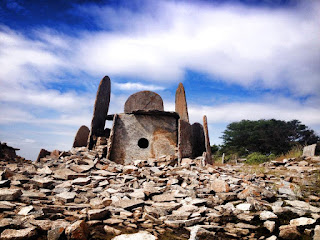
Dolmens, cairn circles, hero stones are megalithic burial sites seen all over Tamilnadu. Dolmens go by various names like Vaaliyaar veedu, kurakku pattadai, Pancha Paandavar padukkai and more popularly as veerakkal or nadukal.  Often personal effects of the buried are also found in small pots with the sarcophagus.


Megalithic cairn circle, Tirupporur
Photo : VSS Iyer


Dolmen 1
photo: Sukavana Murugan

Dolmen 2
photo: Sukavana Murugan

While usually dated to 7th and 8th centuries BC,  some have been dated to as late as the fifth century AD.

Tolkappiyam lists six stages in planting a memorial stone – nadukal

  • Selection of suitable stone
  • Quarrying it
  • Soaking it in water
  • Planting and consecrating after carving the image
  • Offerings
  • Prayers

Other texts list similar stages, but include a final stage where a King or Chieftan builds a temple over the planted stone. These are also listed as kaatchi kaadhai, kalkoL kaadhai, neerpadaik kaadhai, nadukar kaadhai and vaazhthu kaadhai in Silappadikaram.

A Purananuru poem on the death of Kopperunchola by the poet Pottiyar ends “Let us sing the glory of our patron who has become a planted stone.”

A burial urn was made for Nedumavalavan, and a poem addresses a potter that to make his urn, “the whole world should be used as a wheel, and lofty mountain as a lump of clay, suited to his fame.”

Burial urn, Adichanallur, Tamilnadu
Inscriptions Exhibit, Madras University 


A poem of Avvaiyaar on the death of Athiyaman Neduman Anji says a Nadukal was erected for him. It was decorated with peacock feathers and liquor was sprinkled

Nagaswamy connects these customs with current Hindu cremation ceremonies. He cites the contemporary funeral of a Brahmin woman, after whose death two stones were planted, one on the bank of a river, another at the entrance to the house of the deceased; called nadi-theera-kuNDa and gruha-theera-kuNDa respectively. Water was sprinkled over the stone with a towel (vasa udaka) and sesame seeds ( tilodaka ) offered. A potful of drinking water was placed over the stones.A lamp was kept burning throughout. This Vedic ceremony strongly resembles the ceremonies for Athiyaman sung by Avvaiyaar.

The very large number of dolmens and hero stones suggest that these were for all classes of people, including women, in the ancient times. Later this was limited to men of valour and fame.

Bodhyana, Katyayana, and the Vaikhanasa Sutra describe procedures for burial of dead or their ashes. Udayana’s elephant Badraapati which fell in war, was honored by a life size stucco image in a temple and regular worship was arranged, as related in Perunkadai. 

In later times Raja Raja built a colony of housing for dancers around the Big temple. A colony of dancers was established around the temple, Brahmins were fed monthly and a water shed erected for travelers. There were arrangement for exposition of kaavya-s and puraaNa-s. This shows that deification of dead and customs to commemorate them were universalised.

Photo Credits

Dolmens: Sukavana Murugan, Pennar archaeological forum, Krishnagiri 

Burial urns : Inscriptions Exhibit, University of Madras

Cairn circle : VSS Iyer

------------

This essay is one of a series of summaries of papers presented in international seminars by Dr Nagaswamy. The summaries in this series were presented by me at a lecture titled Nagaswamy - Beyond Borders at Tamil Heritage Trusts' Pechu Kacheri 2014 at Tatvaloka, Chennai.

My blogs on history

My blogs on art


Friday, 4 February 2022

Nagaswamy - 6 Temples of Village Gods

Village shrine under a tree
(near Kanyakumari, Tamilnadu)

Village temples in India owe their origin to tribal belief in nature spirits and in their benevolent and malevolent powers. Trees, rivers, mountains, tanks, the sea, lightning, wind and the like have grown into making village temples. Fertility cults, Mother Goddess, Village goddess, Border Guardian are also common

Village guardian deity (near Vilupuram, Tamilnadu)
with uniformed police!


City Goddesses

There are references to the deity of the city of Pushkalavati in inscriptions. Campapati was the Goddess of the city of Kaveripumpattinam, also called Campa, as was Madurapati for Madurai.

Ayyanar, near Arasur, Vilupuram district
Photo: Thyagarajan Ekambaram

Nagaswamy suggests that the hunter Revanta, son of Surya, hunting with dogs on his horse, has taken the shape of Ayyan Mahashasta, popularly called Ayyanar. Revanta is mentioned in texts in Kerala while Silappadikaram refers to Sasta or Masaattan. Huge terracotta horses, or elephants, related to Ayyanar can be found in every village in Tamilnadu, often accompanied by his consorts Purana and Pushkala. Pidari gods can also be found in several villages.

Revanta and dogs,
Ayyanar temple, near Vilupuram


Adayar Munisvarar


SaptaMatrika and Nagas

Temples dedicated to SaptaMatrikas have a place in the layout of villages. Naga cults are omnipresent also, the antiquity of which is lost in the prehistoric period. Stones with inscribed snakes and worship of anthills considered as snake dens are common. This serpent cult was associated with fertility cults, worshipping of snake is believed to help deliver children.

Naga images, Perungulam, near Tirunelveli, Tamilnadu


Hero Stones

Worship of heroes who have laid down their lives for community are commemorated with hero stones, called Nadukal, found in thousands in Tamil Nadu, Andhra, Karnataka, Maharashtra, Saurashtra and Himachal Pradesh. Often erected as dolmens, with three upright slabs and topped by a capstone, they have the figure of the hero carved on the slabs, usually with weapons like spears, sword or bows and arrow. Accessories like a container with lid, a spouted pitcher or a mirror are often shown with them.

A common belief was that a heroic death ended in an ascent to heaven. The spirit of the hero is believed to reside in the stone and act as a guardian. When communities migrate they take their hero stones and beliefs with them. Some of these heroes are elevated to status of deities. Often these may be community heroes even unfairly executed by orders of a king.

Madurai Veeran, Sudalai Madan, Annanmaar, Karuppanan have such legends around them.

nadukal - hero stone - man who killed a tiger


Brave Animals

In an incident where a hero guarding buffaloes was killed by robbers, but his dog chased the robber, and was also killed. Villagers honored both dog and master by erecting hero stones and portraying their figures. This is oldest known memorial for an animal. A rooster also earned a hero stone in the 7th century!

Hero stone for two dogs which died fighting a wild boar
8th-9th century
Inscriptions Exhibit, Madras University


Chaste Women

A chaste wife dying in a sati, a wronged women, these too become objects of worship. Kannagi of Silappadikaram, who was worshipped Vira maa pattini is the outstanding example. Tribals to emperors thronged to worship her.

Renuka, mother of Parasurama, whose was ordered to be beheaded by her husband is also one such goddess. In several temples, the severed head of Renuka is the object of worship. Offerings of food, animal sacrifices and liquor are common and are then ceremoniously partaken by worshippers. Nagaswamy opines that such animal sacrifices are blown out of proportion.

sati stone - Madras Egmore museum

Folk Festivals

Celebrated annually, with communal dancing and singing, trances and soothsaying, prayers to ward off diseases and troubles, holding courts to solve domestic problems and disputes, folk festivals play an important part of village life. These are the prime inspiration for folk music and dance. Hundred of ballads commemorate folk heroes. Since village folk are excessively conservative, their dresses ornamentation and mode of singing have been conserved for centuries. Folk customs have merged into the classical in later times. 

------------

This essay is one of a series of summaries of papers presented in international seminars by Dr Nagaswamy. The summaries in this series were presented by me at a lecture titled Nagaswamy - Beyond Borders at Tamil Heritage Trusts' Pechu Kacheri 2014 at Tatvaloka, Chennai.

My blogs on history

My blogs on art