Showing posts with label mathematics. Show all posts

Thursday, 24 April 2025

Aryabhata

The Genius and the Myth

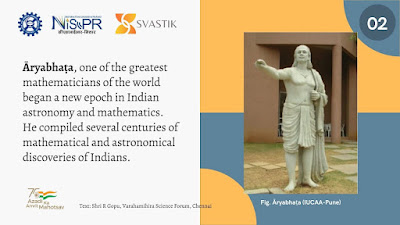
He ranks with Archimedes, Euclid, Isaac Newton and Leonard Euler as one of the greatest mathematicians of the world. He began a new epoch in Indian astronomy and mathematics, that continued for more than a millenium. His book Aryabhateeyam is a masterpiece of brevity and eloquence.

But what did Aryabhata actually do? Aryabhata did NOT invent zero; or gravity; or the heliocentric system. As I wrote in my first essay, even Indian mathematics and Sanskrit scholars are stunningly ignorant of Aryabhata’s actual accomplishments. Since we are equally ignorant of almost all of ancient India’s glories, this is not specifically galling; just generally abysmal. Only Bhaskara was perhaps as popular and admired, but unlike Newton’s apple or Watt’s tea kettle, or the anecdotes of Birbal or Tenali Raman, we don’t even have popular legends about him. But we are so creative, we blame the British for this situation, decades after they left.

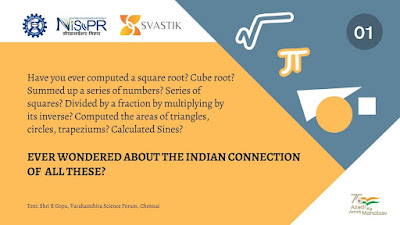
Ever computed a square root? Aryabhata.
Cube root? Aryabhata.
Summed up a series of numbers? Aryabhata.
Series of squares? Aryabhata.
Divided by a fraction by multiplying by its inverse? Aryabhata.
Computed the areas of triangles, circles, trapeziums? Aryabhata.
Calculated sines? Aryabhata. 

And that’s just the simple mathematics we learn in school.

Wait! Did he invent ALL of these? Ah, that’s the question. Aryabhata himself claims not a single invention. He explicitly states that “by the grace of Brahma, the precious jewel of knowledge (jnana-uttama-ratnam) has been extracted from the sea of true and false knowledge (sat-asat-jnaana-samudraat), by the boat of my intellect (sva-mati-navaa).” As Euclid compiled five centuries of geometrical discoveries of the Greeks, Aryabhata compiled several centuries of mathematical and astronomical discoveries of Indians.

Sulba sutra and Jain mathematicians knew how to compute, square roots, but Aryabhata was the first to describe the algorithm. We don’t know if cube roots were calculated earlier, his algorithm is the oldest extant. His sine calculations are considered much superior to those listed by Varahamihira. His kuttakara algorithm to find solutions is considered ingenious even today.

It is not feasible to explain his mathematical and astronomical discoveries in a magazine article for the general reader. There are excellent translations, technical papers, books that do that. This essay’s purpose is to provoke you to read them, and marvel at Aryabhata’s sva-mati-navaa. And to place Aryabhata and his work in historical context.

Manuja Grantham

The eighteen siddhantas were attributed to rishis. But every jyotisha siddhanta after Aryabhata and Varahamihira, is attributed only to men, not rishis. These arose from commenting, understanding, questioning, correcting, improving existing siddhantas and inventing or discovering new concepts. There was no fear or taboo against criticizing a mere manuja like Aryabhata or Bhaskara, rather than a rishi. This era of Mathematics and Astronomy is called “Classical” by historians. I prefer VarahaMihira’s phrase Manuja Grantha.

मुनिविरचितमिदमिति यच्चिरन्तनं साधु मनुजग्रथितम्
तुल्येऽर्थेऽक्षरभेदादमन्त्रके का विशेषोक्तिः ॥१–३॥ – बृहत्संहिता

muni-viracitam-idam-iti yat-cirantanam saadhu na manuja-grathitam
tulye-arthe-akshara-bhedaad-amantrake ko viSheshokti – BrihatSamhita 1-3

 Translation This (idam) is muni-uttered (muni-viracitam) so sacred (cirantanam) and good (saadhu). Not (na) so manuja-grathitam (man-composed) it is said (iti). If it is not a mantra (amantraka), and meaning (artha) is equal (tulye) but words different(akshara-bhedaa), what’s wrong (vishesha) with it?

Philosophically, this verse by Varahamihira, is as insightful and expressive as Kalidasa’s verse puraanamityeva na saadhu sarvam(Not everything is excellent, simply because it is ancient). 

Aryabhateeyam

The phrase Kusumapure abhyaarcitam gnaanam (knowledge respected in Kusumapura), in Aryabhateeyam hints that he lived in Kusumapura (Pataliputra or Patna). No biography or portrait of any Indian astronomer exists. The pictures of Aryabhata pervading the internet, as well as his statue, are merely artists’ imaginations. Almost all we know about him comes from his books and those of his critics and commentators, like Brahmagupta and Bhaskara I, who mentions Pandurangasvami, Latadeva and Nishanku, as pupils of Arybhata.

He composed:

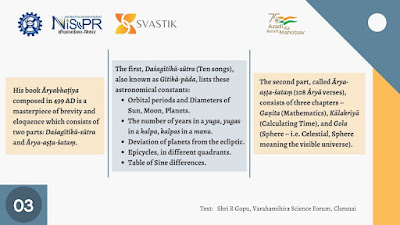
(1) Aryabhateeyam in 499AD when he was 23 years old. Multiple copies survive in full form.

(2) Aryabhata Siddhanta, which is lost, and known only by quotations from commentators. In this book, Arybhata advocated midnight as the starting hour of each day, instead of sunrise, perhaps based on Surya or Romaka Siddhanta. Aryabhateeyam uses sunrise as day-beginning.

I confine this essay to Aryabhateeyam. It consists of two parts. The first, Dasha Geetika (Ten Songs), lists astronomical constants:

·        Orbital periods and Diameters of Sun, Moon, Planets

·        Number of years in a yuga, yugas in a kalpa, kalpas in a manu

·        Deviation of planets from the ecliptic

·        Epicycles, in different quadrants

·        Table of Sine differences.


His first verse is a salutation to Brahma - he was a scientist, but not an atheist. Almost every jyotisha who followed him begins his work with a salutation to his favorite God. Jain mathematician Mahavira begins with an invocation to his namesake, the tirthankara Vardhamana Mahavira. It may also indicate that he was updating the Paitamaha (Brahma) siddhanta, some of whose data, had become obsolete.

The second part, called AryaAshataShatam (i.e The 108 Arya verses) consits of three chapters – Ganita (Mathematics), Kaala Kriyaa (Calculating Time), and Gola (Sphere – i.e. Celestial, Sphere meaning the visible universe).

The siddhantas of later jyotishas were each nearly a thousand verses long. What Aryabhata summaries in one or two verses is explained by them with whole chapters. So cryptic and compact was Aryabhateeyam, it was impossible to understand without bhashyaas (commentaries); such was its impact, that bhaashyaas were written on it centuries after others improved upon his methods. Telugu Marathi and Malayalam commentaries followed those in Sanskrit, Arabic etc; and English translations in the colonial period, which range in appreciation from astonishment to incredulity to calumny.


1.    Ganita - Mathematics

The mathematics set forth by Aryabhata is mostly practical, not theoretical: its primary purpose is astronomy. I mention only simpler concepts in this essay.

It also varies from extremely simple to extremely complex statements, hypotheses, and algorithms.

We must understand that mathematics was not taught to school children, then as it is today; it was perhaps the most advanced of technical subjects and confined to specialists.  Arithmetic symbols familiar to us like + - x ÷ = were only introduced in fifteenth century Europe. Mathematics was not expressed in equations, but in slokas.

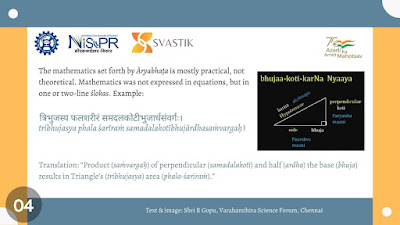
Aryabhata gives two line slokas like this:

त्रिभुजस्य फल शरीरं समदलकोटी भुजार्ध संवर्गः

Tribhujasya phala shareeram samadalakoti bhujaardha samvargaH.

 Bhuja means Arm. Tribhuja means three-armed or Triangle.

Translation “Multiplication (SamvargaH) of perpendicular(Samadalakoti) and half (ardha) the base(Bhuja) results (phala) in Triangle’s (Tribhuja-sya) area(Shareeram).”

A similar verse(sloka) defines the area of a circle as its half-perimeter (or half-circumference) multiplied by its half-diameter (radius) 


This is a simple algorithm, just a formula really, to calculate one value, based on known parameters. A more complex version is his algorithm for summation of a series, which includes several calculations, including for the mean of the series, and encoding an alternate algorithm! This way of stating multiple mathematical formulae is called muktaka by Bhaskara I.

Kaalakriyaa – Time

Aryabhata divided time and circles  with the same geometric units as earlier siddhantas. His major departure, was to define the four yugapadas namely krta, treta, dvaapara and kali, as of equal time; and as the time it took all the nine planets to align, or complete an integral number of revolutions around the earth. He included a biographical note, that 3600 years passed between the beginning of Kali yuga (end of Mahabharata war) and the twenty-third year of his birth. This implies that the constants in DashaGitike were based on his personal observations in that year.

This differed from the smriti definition of the first three yugapadas as four, three and two times as long as the kaliyuga, and offended the orthodox of everyone. Even his followers didn’t accept this division, but they followed his computations and algorithms, as they were significantly better than those of earlier siddhantas.


Gola – Celestial Sphere

Arybahata states that Solar and Lunar eclipses are shadows of the Moon on Earth and Earth on the Moon, respectively. He also stated that the  Sun is the only source of light, and not just planets, but even the stars only reflect sunlight.

Kadamba flower

Aryabhata used the metaphor of a kadamba-pushpa-grantha,  to explain how people and creatures in all parts of the world believe they are standing on top of the world. He introduced another metaphor, for Earth’s rotation: consider a boat-rider on the Ganga, who feels trees on the shore pass him by; whereas, in reality it is the boat that is moving. Similarly Aryabhata suggested, the earth actually rotates, and like trees on a river bank, the stars seem to revolve around it. But it was only a metaphor, not a proof.

He also explains such concepts as Ascencions of the Zodiac, Sine of Ecliptic etc. which are too technical for this essay.

The impact of Aryabhata was phenomenal. Even fervent critics could not ignore him or his works. But he launched an era of manuja grantham, and he was followed by a long line of brilliant scholars, whom we will discuss next.

-----------
This essay was first published as part of a series in Swarajya
For the entire series click this link --> Indian Astronomy and Mathematics   

References

1.      The Aryabhateeyam by Walter Eugene Clark, University of Chicago, 1930.

2.      Aryabhatiyam, translated by KV Sarma and KC Sukla, Indian National Science Academy, New Delhi, 1976.

3.      Facets of Indian Astronomy, KV Sarma, Madras.

Related Links


Sunday, 30 March 2025

Sanskrit and other Languages of Science

In 1999, I read the Tamil historical novel Sivakaamiyin Sabatham. Set in the seventh century, the novel tells of the siege of Kanchipuram, the capital of the Pallavas, by their rivals, the Chalukyas. It is still one of the most popular books in Tamilnadu, seventy years after its first publication. At one point in the story, Aayanar, an artist and sculptor tells the Pallava king Mahendra Varma, that his deepest desire is to know the secret technology of  Ajanta paintings, which have lasted a thousand years without fading. The paintings of Ajanta are still there, a thousand years after the Pallavas and Chalukyas disappeared.

In Kanchipuram, the Kailasanatha temple built by Mahendra Varma’s great grandson Rajasimha Pallava in the eighth century, has paintings in the Ajanta style, which have sustained damage but what remains hasn’t faded. The contemporary Pandyas built a Jain cave temple of Sittannavasal, which has equally remarkable paintings.

A heritage of science and technology

These struck a severely discordant note. How many advertisements do we see on television for the latest paints that last twenty years? Enamel paints manaufactured in large chemical plants, based on the very latest technology brought to life by the most brilliant chemical engineers of the last century. Their great selling point is that they last twenty years – one hundredth of the two thousand years that Ajanta paintings have lasted, in primitive caves, sculpted by hammer and chisel.

What other remarkable scientific and technological achievements of ancient Indians was I missing?

By sheer coincidence, I happened to attend a series of lectures about the “Oral Traditions of the Sanskrit” language, by Prof Swaminathan, a retired IIT Delhi professor of mechanical engineering. He explained the Siva sutras (also called Maheshvara sutras) and how Panini used them to write extremely compact rules of grammar for Sanskrit. The Siva Sutras and Panini’s sutras reminded me starkly of the Backus-Naur notation, that every computer science or engineering student learns in college. But, wait! What was Panini doing, composing Sanskrit grammar in Backus-Naur notation?

Why is Panini never mentioned in any computer science course? Why is not a single discovery  of Baudhayana, Aryabhata, Brahmagupta or Bhaskara ever taught in a mathematics or engineering course? In any school or college? Seventy years after independence, you can hardly blame British colonialism.

The ignorance is not merely about Indian science, it is about all non European science and technology, in general. Sumeria, Egypt, China, MesoAmerica (Olmecs-Mayans-Aztecs), Persia, all ancient civilizations are totally ignored, and we get an entirely European perspective of all science and technology.

English is the language of science, we are told, though most of the scientific vocabulary is in Greek or Latin. The very names of the sciences Physics, Biology, Zoology, Geology, Astronomy come from Greek. Chemistry, is an exception, adapted from the Arabic word AlChimia (or Alchemy). The  different fields of mathematics, Geometry, Trigonometry, Arithmetic have Greek origins. But Algebra comes from an Arabic word; Calculus from a Latin word. Newton wrote his most famous physics book, “Principa Mathematica de Naturalis” in Latin, not English. When Antoine Lavoisier coined new words for the modern chemistry he discovered, he did not use French; he chose Greek and Latin. English words like soda and pot ash, were Latinized into Sodium and Potassium.

A mathematical vocabulary

Did the Sumerians, Chinese, or ancient Indians use Latin or Greek? Or even need them? Obviously not. It was when I started reading the Aryabhateeyam in its original Sanskrit (with English translation assisting), that I realized what a rich vocabulary we are ignorant of.

Do you recognize the following words: vishkambha, parinaaha, kakshya, vishuvat, karna, jyaa?

How about these words : diameter, circumference, orbit, equator, hypotenuse, sine?

Here’s the stunnner. The first row of Sanskrit words have the exact same meaning as the second row of English words.

समपरिणाहस्यार्ध विष्कम्भार्धहतमेव वृत्तफलम्

Transliteration sama pariNaahasya ardha vishkamba ardha hatameva vrtta phalam

Let me explain this Sanskrit statement, word by word:

Sama – equal
Parinaaha – diameter
Ardha – half
Vishkambha – circumference
Hatam – multiply
Eva – exactly
Vrtta – circle
Phalam – result 

Literarlly “Equal diameter-half circumference-half mutliply-exactly circle’s-result”

Rephrased grammatically in English : “A circle’s area equals half the diameter  multiplied by half the circumference”.

This was stated in Sanskrit by none other than Aryabhata. It is the seventh sloka in his Aryabhateeyam.

Let me propose two quick quizzes: there are two lists of names side by side, one European, the other Indian. Just write down what they invented or discovered, as a self-test.


You can the internet to verify your answers. But did you get all answers correctly in the first list? How did you fare with the second list? Did you even recognize all the names? (Confession: I didn’t know three of them ten years ago). If you guessed that Aryabhata invented zero or discovered gravity or the heliocentric theory, give yourself negative marks. He didn’t.

But the people on the second list had one things in common. They all used Sanskrit as the language of science. Why Sanskrit? Sanskrit was not only the language of religion, and literature, it was also the language of several sciences, law, justice, administration, economics, rhetoric, logic, and several arts, namely music, dance, painting, sculpure, architecture etc. It served the same function in India and countries to the east of India, that Latin first in the Roman empire, then in Europe until perhaps the twentieth century; what Mandarin did in China from Confucian times upto perhaps today; what Arabic did in the realms of Islam. It was the link language of a cultural continent, across several kingdoms over the span of several centuries, even millennia.

Consider these somewhat famous books.


I have provided only one example in each field. In reality, each field has several books, written by scholars from various regions or cities, across several centuries. We never hear of them, because over time, Sanskrit has become more alien in India than Greek or Latin.

Now consider that quiz, again. Why is that ignorance of the inventions or discoveries of Europeans considered scientific illiteracy, but ignorance of the inventions of discoveries of Indians considered normal? It may be tempting to Islamic desturction or European colonialism. But I don’t think that is an acceptable excuse, seventy years after Independence.

When most Indians, hear Sanskrit or hear of it, we only hear of it as the language of the Vedas, or at best the language of beautfiul poetry as in Kalidasa or Jayadeva. One popular understanding is that it is a dead language, steeped in the superstition of religion. The only people talking in public about anything Sanskrit are people quoting philosophy; once in a blue moon, perhaps a musician or a dancer. Or, a chorus chanting Sanskrit mantras as background music in a Star Wars movie.

Buddhist and Jain Sanskrit literature

Sanskrit was not the only language in which science was written, in ancient and medieval India. The Jains and Buddhists wrote books on some sciences in several Prakrits, primarily Ardha Magadhi and Pali. They believed that Sanskrit was the language of the elite, and to reach the common man, the local languages should be used. But this soon led to severe fragmentation of literature. The Kushana king Kanishka convened a Buddhist Sangha in Kashmir, at which scholars began to translate several Buddhist canonical texts from Pali to Sanskrit. From then on, several original works, including on mathematics, were composed in Sanskrit also. Similarly, Jains composed Sanskrit works from the fifth century onwards, after the Valabhi Sangham. The first Sanskrit book where mathematics is the primary subject, not a chapter in an astronomy book, is Ganita Sara Sangraha, composed by the 9th century Jain mathematician Mahavira. A few stanzas of his first chapter, beautifully outline the use and power of mathematics. It should be declared the Mathematics Anthem, and printed on the first page of ever math text book. I suspect Finland or Cambodia will do it, and then India will rush to follow. Here it is, with my translation:

लौकिके वैदिके वापि तथा सामायिकेऽपि य: |
व्यापारस्तत्र सर्वत्र संख्यानमुपयुज्यते || ९

कामतन्त्रेऽर्थतन्त्रे च गान्धर्वे नाटकेऽपि वा|
सूपशास्त्रे तथा वैद्ये वास्तुविद्यादिवस्तुषु || १०

छन्दोऽलङ्कारकाव्येषु तर्कव्याकरणादिषु |
कलागुणेषु सर्वेषु प्रस्तुतं गणितं परम् || ११

Translation

In worldly life, in Vedic learning, in religious practice, 
In business, in everything, Mathematics is useful.

In romance, economics, in music dance and drama,
In cooking, medicine and in architecture, 

In prosody, poetry, logic and grammar,
In all the arts, Mathematics reigns supreme.


The libraires of Alexandria and Nalanda may have been destroyed by iconoclastic invaders, but the library of all Sanskrit knowledge is vandalized every day, by our collective ignorance and negligence.

That is ridiculous. We can change that.

References

  • 1.     Facets of Indian Astronomy, KV Sarma, 1975
  • 2.     The Aryabhatiya of Aryabhata, Walter Eugene Clark, 1930
  • 3.   Mahavira's Ganita Saara Sangraha, Prof Rangacharya, Univ of Madras, 1912 

__________

This was the first of a series of essays published in Swarajya magazine online

For the entire series click this link --> Indian Astronomy and Mathematics   

Related Links

My blogs on Astronomy and Mathematics

Shilpam Science Sundaram - TEDx lecture at Saveetha Eco Pupil school

Thursday, 19 January 2023

Indian Science Festival - Hyderabad

I will deliver a talk titled "Varahamihira's Eclipse Proof" at the Indian Science Festival, Hyderabad, at 11am this Saturday 21st January 2023. At Nucleus Arena.

Entry is free to public. Click here for Registration, schedule  


I will also conduct a workshop on Aryabhata's square/cube roots algorithms at 12pm on Sunday January 22. Limited seats. 


Addendum Feb 24: I wrote an essay summarizing some of what I heard at ISF, Hyderabad and it was published in SouthFirst magazine. Read it here!

In 2020, Badri Seshadri and I presented talks on Indian Mathematics titled The Men who knew Zero to Infinity at ISF Pune. Video links are below:

Part 1 : R Gopu

Part 2 : Badri Seshadri


Monday, 10 January 2022

இந்திய கணிதம் - தகவல் இதழ்கள்

CSIR (சி.எஸ்.ஐ.ஆர் ) என்னும் நிறுவனத்தின் ஒரு கிளை NIScPR (தேசிய அறிவியல் கொள்கை பரப்புக் கூடம்) அறிவியல் தகவல்களை பரப்பிவருகிறது. அதில் சுவஸ்திக் என்ற ஒரு திட்டத்தின் கீழ சமீபத்தில் இந்திய கணித மரபை உரைக்கும் தகவலிதழ்களை (போஸ்டர்/சுவரொட்டி) தயாரித்துள்ளனர். அவர்களுக்கு என் மனமார்ந்த நன்றி. மேலும் இதுபோல் மேலும் பல தகவல் இதழ்களை வரும்நாட்களில் உருவாக்குவார்கள்.

நான் சில மாதங்களுக்கு முன் எழுதிய கட்டுரைகள் இந்த தகவல்களுக்கு அடித்தளமாக அமைந்தன. சில மாதங்களுக்கு முன் தமிழில் இந்திய கணித வானியல் மரபை ஒரு பாடதிட்டமாக வகுத்து, வராகமிகிரன் அறிவியல் மன்றத்தில் நாங்கள் நடத்தியது நினைவிருக்கலாம்.

இந்திய அறிவியல மரபை பற்றி ஆர்வலர் அறிய, இதை நீங்களும் பகிரலாம். 

இங்கே இந்த இதழ்களின்  டுவிட்டர் பகிர்வு

இங்கே இந்த இதழ்களின் முகநூல் பகிர்வு 

ஆரியபடன் - தமிழ் கட்டுரை

இந்த வலைப்பூவில் என் கணித கட்டுரைகள்


Friday, 31 December 2021

Indian Mathematics posters

The National Institute of Science Communication and Policy Research (NIScPR) at CSIR has created and released a few posters on Indian mathematics to promote awareness.

They have shared them on Twitter 

Here are the posters : they are about the contributions of Aryabhata. I hope they are useful to enthusiasts. My essays about Aryabhata as part of a series in Swarajya, give more details about his contributions. 


A podcast on Aryabhata with Moumita Mazumdar of CSIR NiScPR

Indian Mathematics - Introductory series: Swarajya magazine
Aryabhata - essay in The Week magazine


Sunday, 27 October 2019

Swarajya series on Indian Astronomy and Mathematics

Swarajya magazine is publishing a series of my essays about Indian Mathematics and Astronomy. I'll add links to new essays as and when Swarajya publishes them.

Swarajya's Contents page for these essays

Links to Swarajya series essays in my blog

3. Number Notations in Sanskrit
4. Astronomy and Mathematics in the Vedas
5. Era of Vedangas
7. Classical Era - Aryabhata
8. Varahamihira's Eclipse Proof
9. The Classical Era - Brahamagupta to Bhaskara
10. The Kerala School of Mathematics and the Modern Era

Links to essays in Swarajya's website

1. Sanskrit - A Language of Science

2. An Introduction to Indian Astronomy

3. Number notations in Sanskrit

Astronomy and Mathematics in the Vedas

5 The Vedangas (mathematics in prosody, grammar, shulba sutras)

6 The Eighteen Jyotisha Siddhantas

7 Eclipses as shadows - VarahaMihira's proof

Aryabhata 

9 The Classical era - From Brahmagupta to Bhaskara

10 Kerala school of Mathematics

My other essays in Swarajya

Earlier Swarajya has published my essays on Mamallapuram and Amaravati sculptures, also.

Mamallapuram
Amaravati sculptures
Tamil Heritage Trust

Contents Page for this Blog

Monday, 2 July 2018

The Mathematics of Thales


Most of us who have gone to school, know of Pythagoras, Archimedes, and Euclid as the famous mathematicians of ancient Greece. Some of us have heard of other great mathematicians like Eratosthenes, Hipparchus, Apollonius, Aristarchus, etc. But, Thales?

Most schools of the world today, I suspect, teach science and mathematics from a predominantly European syllabus. This is partly an effect of European colonization of most of Asia and Africa, and dimunition of native populations in the Americas and Australia,  in the eighteenth, nineteenth and twentieth centuries of the Christian calendar.

I am currently reading a book titled “Archimedes” by Thomas Little Heath, originally published in 1920, on Kindle. It is a free download, and part of a Men of Science series.

“Greek authors from Heredotus downwards (meaning, after him) agree in saying that geometry was invented by the Egyptians and that it came into Greece from Egypt,” writes Heath.

He quotes an account : “Geometry is said to have been invented among Egyptians, its orgin being due to the measurement of plots of land. This was necessary because of the rising of the Nile, which obliterated (erased) boundaries appertaining to separate owners…. Thales first went to Egypt and thence introduced this study into Greece.”

What we know today as the Pythagoras theorem, about the hypotenuse of right angled triangles, is listed as Proposition 47 in Volume I of Euclid’s “Elements”, the standard European and Arab book of mathematics from the first to eighteenth centuries. The word Elements is the Greek word for Numbers, which in the eighteenth century was adopted into French, English etc for the most basic objects in Chemistry. The word Geometry is formed from two words Geo (Earth) and Metry (measurement). The Sanskrit word for measurement is Maatra. Greek and Sanskrit are part of the Indo European language family, so these words originate from the same root. The Sanskrit word for geometry is Shulba Sutra. Shulba is the Sanskrit word for rope or string; the earliest surviving books are not about  land measurement or business but measurement of altars for yajnas. Parallelly, jyotishaas (astronomers) developed a different stream of mathematics to determine time based on the movement of celestial objects.

“Thales, who had travelled in Egypt and there learnt what the priests could teach him on the subject, introduced GeoMetry into Greece. Almost the whole of Greek science and philosophy begins with  Thales. His dae was about 624-547 B.C. First of the Ionian philosophers, and declared one of the Seven Wise Men in 582-581, he shone in all fields, as astronomer, mathematician, engineer, statesman and man of business,” says Heath.

What fascinated me is what follows, which is Heath’s listing of the contributions of Thales to mathematics and astronomy.

In Astronomy, Thales:
  • Predicted the solar eclipse of 28 May, 585 BC
  •  Discovered the inequality of the four astronomical seasons
  • Counselled the use of the Little Bear instead of the Great Bear as a means of finding the pole (i.e. North Pole)

In Geometry, the following theorems are attributed to Thales:
  1. That a circle is bisected by any diameter
  2. That the angles at the base of an isoceles triangle are equal
  3. That if two straight lines cut one another, the vertically opposite angles are equal
  4. That if two triangles have two angles and one side respectively equal, the triangles are equal in all respects (what we now called Side-Angle-Side congruency)
  5. Was first to inscribed a right angled triangle in a circle, which means he was first to discover that the angle in a semi circle is a right angle.


Thales also solved two problems in practical geometry
  •         He showed how to measure the distance from the land, of a ship at sea (using Proposition 4 above)
  •         He measured heights of pyramids by means of the shadow thrown on the ground


Heath adds, “Their character (of the theorems) shows how the Greeks had to begin at the very beginning of the theory.”

Thales was a practical man, a businessman, and indulged in theoretical excursions perhaps as a pasttime. Pythagoras came a generation after him, and founded a school of mathematics. Euclid’s famous Elements is dated to the first century, AD, six hundred years after Thales. Pythagoras was interested in Mathematics as a leisure activity and an intellectual pursuit. So were most of this followers; his students and such people who pursued Geometry as an intellectual pursuit were collectively called the Pythagoreans. They coined the Greek word Mathemata (μάθήμάτα) from which comes the English tatbhava word Mathematics. The Greek word Mathemata literally means “Subjects of Instruction”.

Both Thales and Pythagoras traveled extensively around and past the shores of the Mediterranean sea, not just Egypt. Other historians of mathematics conjecture that Pythagoras traveled to Persia and perhaps even India. Ancient Greeks themselves acknowledge the Egyptian origins of their mathematics. Through formal and inductive methods, and intellectual pursuits, the Greeks elevated mathematics to a much higher levels, especially in Geometry. Strangely very few people of the Roman Empire that succeeded Hellenic Greece did not continue in this path, though the Persians and central Asians who acquired Greek books via Alexander of Macedonia’s conquest, did. Europe almost entirely abandoned mathematics and science for a millennium, until the emergence of Italian city states and Fibonacci’s ventures to Baghdad.

Pythagoras is introduced to us as the fountainhead of Greek mathematics, just as Aryabhata or some Vedic rishis are mentioned as the fountainhead of Indian mathematics. No mention is made at all of the Egyptian origins of Greek mathematics. Similarly while there are some references to Greeks and Romans in Indian mathematical texts, especially of Varahamihira, in those times, there was no attempt at studying the history of mathematics or acknowledging foreign elements borrowed.

I find Thales a fascinating character, more so perhaps than even Varahamihira. He reminds me of Benjamin Franklin, Antoine Lavoisier and Sir William Jones. And Mahendra Varma Pallava.

I strongly recommend Heath’s biography of Archimedes, from which I have excerpted. The list of his books and their titles also tell you what the level of mathematics was in Hellenic Greece. I also hope to read some biography of Apollonius, whom Simon-Pierre Laplace equates with Archimedes as the great mathematicians of ancient times.

On a linguistic note, you can read each letter in the word μάθήμάτα based on Greek letters use in modern mathematics texts – mu, alpha, theta, eta, mu, alpha, tau, alpha. Notice that Greek has separate letters θ and τ for tha and ta like Sanskrit and Tamil, whereas English doesn’t. So English has to use two letters th for the equivalent of theta or த. That’s another story for another occasion, another blog.

There seem to be some pictures or sculptures of Thales, though I don’t know if they are authentic.
Thales - source : Wikipedia
This one is from Wikipedia. Several Greek philosophers kings and others were depicted in paintings on vases, stone sculptures, bronzes, etc. Unfortunately such depictions in India were rare before the Gupta period; any pictures you see of mathematicians like Aryabhata, Bhaskara, or Varahamihira are entirely the product of recent artists’ imaginations.

Related Blogs and Videos

  1. Archimedes by Thomas Little Heath (free Kindle edition)
  2. Detailed article on Thales
  3. Video of my talk on Astronomy and Mathematics of Ancient Cultures
  4. My essay on Aryabhata (The Week magazine)
  5. Notes from Manjul Bhargava lecture on history of Indian mathematics
  6. Antoine Lavoisier


Friday, 4 May 2018

Indian Mathematics and Astronomy - A summer course

Have you heard of the Ujjain Meridian? It was used for 1500 years, but why is it unknown to Indians, unlike the Greenwich Meridian?
How did Aryabhata Brahmagupta Bhaskara and Varahamihira do mathematics without knowing English or Greek? Was Sanskrit only the language of rituals and literature, or also of mathematics and science? Can you calculate long divisions in very narrow palm leaves?

How did Indians tell time, predict eclipses, make calendars and mark dates for religious festivals like Kumbha Mela or Mahamagham before the mechanical clock was invented in the seventeenth century? And what mathematics or astronomy did the Egyptians Chinese Sumerians Persians and Mayans understand or discover?

Learn the answers to these questions.

Learn the history of Indian mathematics and astronomy and its various texts, including Siddhantas, bhashyas, karanas, and panchangams. Discover Baudhayana’s geometry and Brahmagupta’s algebra. Discover the long history of Indian Astronomy before the telescope, Indian mathematics before Aryabhata, the connections from Brahmagupta to Baghdad to Fibonacci and other surprising and interesting facts that pervade your everyday life even today.
You can send me a Whatsapp message on +91 9841724641 or email to writergopu@gmail.com to register or ask questions on the course
My blogs on this theme

Friday, 4 August 2017

A Sanskrit anthem for Mathematics

தமிழில் இந்த கட்டுரை

In the ninth century, most of today’s Karnataka was ruled by a king of the Rashtrakuta dynasty called Amogavarsha Nrpatunga. One of his inscriptions says that his kingdom extended from the Godavari to the Kaveri, so his territory was not confined to modern Karnataka.This king was also a very special scholar – he composed the oldest surviving great literature in the Kannada language, Kavirajamarga

In his court lived a great mathematician, Mahavira, who composed a book titled GanitaSaraSangraha. This is as remarkable as Kavirajamarga, because this is the oldest book in Sanskrit,exclusively dealing with mathematics. Hundreds of books  were composed in previous centuries in Sanskrit, including the famous books of Apastambha, Baudhayana, Aryabhata, VarahaMihira and Brahmagupta. But those books were either sulba sutras or jyotisha sutras, and mathmatics was one of the components of those books. 

GanitaSaaraSangraha is the first book where mathematics is the primary subject. Several later astronomers like Madhava, Parameshvara, Bhaskara and Nilakanta Somayyaji wrote books on Astronomy, which had chapters on Mathematics, so the older practice did not fade out.

Prof Rangacharya of Presidency College, Madras translated GanitaSaraSangraha into English in 1912. The book was translated first into Telugu by Pavuluri Mallana, in the eleventh century and most recently in 2000, to Kannada by Prof Padmavathamma, of the University of Mysore. To my knowledge, there is no Tamil translation, except perhaps my own translation of a mere three stanzas.

Mahavira, was a Jain. The first stanza of the GanitaSaraSangraha has the phrase namastasmai jInendrAya mahAvirAya नमस्तसमै जिनेन्द्राय महावीराय (Salutations to Jinendra Mahavira), a reference to the last Jain tirthankara, Vardhamana Mahavira. Interestingly, in their first slokas the Hindu astronomers Aryabhata salutes Brahma, Brahmagupta salutes Siva, and Nilakanta Somayyaji salutes Vishnu. An interesting  comparison may also be made to the famous Meguti inscription of Chalukya king Pulikesi in Aihole, which begins with a similar salutation to Jinendra (Jayati Bhagavaan JinendraH जयति भगवान् जिनेन्द्रः) 

This is the other remarkable aspect, because the book is in Sanskrit, not Prakrit. Popular belief is that most works by Jains and Buddhists were written in Prakrits (Jain works in Ardha Magadhi, and Buddhist works in Pali). While this is true of several Jain and Buddhist compositions of the first few hundred years, not just for philosophy or religion, but also for sciences, later Buddhists and Jains wrote in Sanskrit, which became the lingua franca not just for people who followed the Vedic religion, but also for the sciences and the arts. 

This is an extensive topic, which is not well-known to learned Indians, and I wont discuss it here. But this is very similar to how Latin was used in Europe, after the fifteenth century, not just as the language of the Christian clergy, but also of science and arts. Hence, Linnaeus developed Latin nomenclature for naming plants and animals by genus-species, Newton wrote his book book on physics Principia Mathematica de Naturalis in Latin, chemists from Lavoisier onwards, used Latin words to name most of the elements. And since the laws of Europe use Roman law to guide them, which thence guide the Constitution and laws of former European colonies like India, Pakistan, USA, Australia, most of Africa and the Americas, Latin is the primary language of global law, except in Islamic countries and China.

But in this blog, I wont discuss the new mathematical concepts expounded by Mahavira, but merely quote three stanzas of his poem, which I believe should be declared the Anthem of Mathematics, and included in every mathematics school text book, not just in India, but in every culture broadminded enough to enjoy and agree with this poem. Here is the Sanskrit source and my English translation. My Tamil translation is here

लौकिके वैदिके वापि तथा सामायिकेऽपि य: |
व्यापारस्तत्र सर्वत्र संख्यानमुपयुज्यते || ९
कामतन्त्रेऽर्थतन्त्रे च गान्धर्वे नाटकेऽपि वा|
सूपशास्त्रे तथा वैद्ये वास्तुविद्यादिवस्तुषु || १०
छन्दोऽलङ्कारकाव्येषु तर्कव्याकरणादिषु |
कलागुणेषु सर्वेषु प्रस्तुतं गणितं परम् || ११

laukikE vaidikE vaapi tathA sAmAyikepi yaH
vyApArastatra sarvatra sankhyAnam upayujyate
kAmatantre artatantre ca gAndarve nAtakepi vA
sUpashAstre tatA vaidye vAstu vidyAdi vastushu
cando alankAra kAvyeshu tarka vyAkranAdishu
kalA guneshu sarveshu prastutam ganitam param

Translation

In worldly life, in Vedic learning, in religious practice,
In business, in everything, Mathematics is useful.

In romance, economics, in music dance and drama,
In cooking, medicine and in architecture,

In prosody, poetry, logic and grammar,
In all the arts, Mathematics reigns supreme.

You can listen to this anthem rendered as a song by Diwakara Tanujaha here 

Meaning by words
laukikE – In worldly life
vaidikE – In Vedic learning
vaapi – also
tathA – likewise
sAmAyikepi – in religious practice
vyApAraH – in business
tatra – there
sarvatra – in everything
sankhyAnam – mathematics
upayujyate – is useful

kAmatantre – in romance
artatantre –in economics
ca – and
gAndarve – in music, the art of gandarvAs
nAtake – in dance and drama
api vA - also
sUpashAstre – in cooking
vaidye – in medicine
vAstu vidyAdi vastushu – in architecture and construction

cando alankAra – in prosody and poetry
kAvyeshu – in epic poetry
tarka – logic
vyAkrana- grammar
Adishu – in these
kalA guneshu – in arts
sarveshu – in everything
prastutam – is established (reigns)
ganitam – mathematics
param – supreme

If you liked this essay, you may enjoy reading these related blogs:

0. My Essays on Astronomy
  1. Video of Prof MS Sriram lecture on GanitaSaaraSangraha
  2. The Peacock’s Tail A interesting blog on GanitaSaraSangraha
  3. Field's medallist Manjul Bhargava on Sanskrit and Mathematics
  4. Some astronomy/mathematics slokas in Sanskrit
  5. Nilakantha Somayyaji’s Sanskrit mathematical pun
  6. Atyantakama Pallava’s poem (also sung by Sudharsanam)
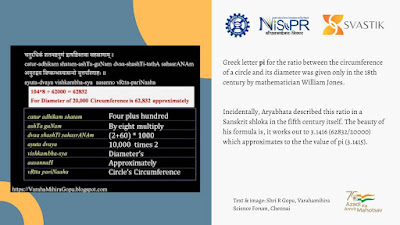
  7. Aryabhata’s sloka for pi
  8. Varahamihira’s salutation to Agastya
  9. My essay on Aryabhata in The Week
  10. A comparison of timelines - Tamilnadu and Karnataka